Table of Contents
Introduction: AI Has Changed Travel But Has It Solved the Biggest Problems?
If you’ve booked a flight online in the last few years, you’ve probably noticed how easy the search process has become. Enter your departure city, choose your destination, compare prices, and within seconds you’re looking at dozens of options. Whether you’re using an airline’s website, Google Flights, Expedia, Skyscanner, or another booking platform, the experience feels remarkably similar. Artificial intelligence has made finding flights faster than ever.
But here’s a question that’s worth asking: what happens after you click “Book”?
For many travelers, that’s where the real journey begins and unfortunately, where many booking platforms stop helping. A delayed connection, a cancelled flight, a missed meeting, or an unexpected change in travel plans can quickly turn a simple booking into a frustrating experience. Suddenly, the cheapest fare you found online doesn’t feel like such a bargain if you’re waiting on hold with an overseas call centre trying to get help.
This is where an AI travel assistant Uganda offers a different perspective. Rather than viewing AI as a replacement for travel professionals, it’s more useful to think of it as the smartest first step in a much bigger travel experience. AI can search, compare, and recommend. It can answer common questions instantly and help narrow down travel options in seconds. However, travel itself is rarely predictable. Plans change. Airlines reschedule flights. Visa requirements evolve. Business meetings move. Families need reassurance.
The real value isn’t simply finding flights. It’s knowing that when something unexpected happens, someone is there to help.
That is the philosophy behind Travelcare’s approach. Instead of using an AI travel assistant Uganda as a standalone booking tool, it acts as the beginning of a managed travel experience. The AI helps travelers find options quickly, understand their choices, and then seamlessly connects them with experienced travel consultants who can provide advice, issue tickets, make changes, and solve problems if things don’t go according to plan.
Think of it like this. AI is an excellent navigator it can point you in the right direction almost instantly. But when the road is closed, the weather changes, or your destination suddenly shifts, you’ll appreciate having an experienced guide beside you. That’s where human expertise continues to matter.
As artificial intelligence becomes a standard part of travel planning, the biggest question is no longer, “Who has the best search engine?” Instead, it’s “Who will still be there after I’ve booked?” That shift in thinking is changing how travelers evaluate travel providers, and it’s why an AI travel assistant Uganda backed by real travel experts is becoming increasingly valuable for both corporate and leisure travelers.
What Is an AI Travel Assistant Uganda?
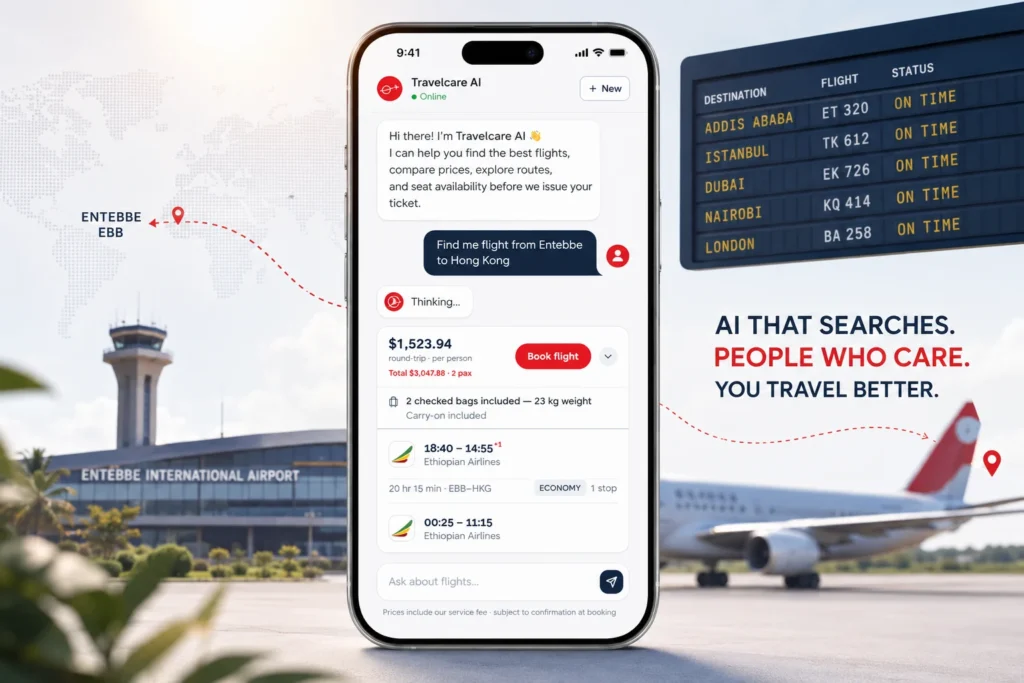
An AI travel assistant Uganda is much more than a digital search box that lists available flights. At its core, it is an intelligent travel companion designed to simplify the planning process, answer questions quickly, and guide travelers toward informed decisions. Instead of spending hours jumping between airline websites and comparison tools, travelers can ask questions in natural language and receive personalized recommendations within seconds.
Imagine asking:
- “What’s the best flight from Entebbe to Nairobi next Tuesday?”
- “Which airline includes two checked bags?”
- “What’s the cheapest morning departure?”
- “Which route has the shortest layover?”
Rather than forcing users to filter endless search results, an AI travel assistant Uganda can interpret the request, understand the context, and present relevant options in a conversational way.
However, there’s an important distinction that many travelers don’t immediately realize. AI doesn’t create flights or exclusive fares. It works with airline schedules and fare data that are already available through global distribution systems and airline inventory. In many cases, the underlying flight information is similar to what you would find on airline websites or large online travel agencies.
So why does AI matter?
Because information alone isn’t the goal. Understanding that information and turning it into the right decision is where intelligence becomes valuable.
For example, two flights may cost almost exactly the same, but one has a risky 50-minute connection while the other allows a comfortable two-hour transit. One fare may appear cheaper but excludes checked baggage. Another may be non-refundable, while a slightly higher fare offers free date changes.
An AI travel assistant Uganda can highlight these differences immediately, helping travelers avoid costly mistakes before they happen.
Even more importantly, when integrated into a travel management environment, AI becomes the bridge between technology and people. Instead of ending the conversation after displaying flights, it can escalate more complex requests to experienced consultants who understand visas, airline policies, corporate travel requirements, and itinerary management.
In this model, AI isn’t replacing travel advisors it is empowering them. Routine questions are answered instantly, while human experts focus on situations where judgment, negotiation, and personal service make the biggest difference.
The Truth About Flight Search: Everyone Sees Similar Flights
One of the biggest misconceptions in modern travel is that every booking website has access to completely different flights. In reality, that’s rarely the case.
Whether someone searches on Expedia, Skyscanner, Google Flights, an airline’s own website, or an AI travel assistant Uganda, the underlying flight information is often sourced from the same airline reservation systems and global distribution networks. The departure times, aircraft, and available seats are generally the same because they originate from the airlines themselves.
For example, if someone searches for an Entebbe–Nairobi return flight, they’ll likely see Uganda Airlines, Kenya Airways, and other available options across multiple platforms. The differences usually come down to how the information is presented, any service fees applied, or promotional agreements with particular providers.
That means the competitive advantage is no longer the flight search itself.
Today’s travelers already have access to excellent search tools. They can compare prices in seconds and check multiple websites before making a decision.
The real question has changed.
Instead of asking, “Who can show me flights?”, travelers are increasingly asking:
- Who explains the differences between similar fares?
- Who helps me choose the right ticket?
- Who assists if the airline changes my schedule?
- Who answers the phone if something goes wrong?
This is where many booking engines reach the end of their service.
They help customers search.
They help customers pay.
After that, support can become limited, automated, or difficult to access.
That’s why positioning an AI travel assistant Uganda as merely another search engine misses the bigger opportunity. Search has become a commodity. Travel management has not.
The companies that stand out are no longer those with the biggest flight database. They are the ones that combine intelligent technology with accessible, knowledgeable human support throughout the travel journey.
If Everyone Has the Same Flight Data, What Really Matters?
Once travelers understand that most platforms display similar airline schedules and fares, another question naturally follows:
If everyone has access to the same flights, why choose one provider over another?
The answer lies in everything that happens before, during, and after the booking.
Travel is rarely as simple as selecting the cheapest fare. Every itinerary involves decisions that can affect convenience, flexibility, and overall value. Is the layover too short? Does the ticket include baggage? Can the flight be changed without a penalty? Will the airline protect the connection if there’s a delay?
These are the details that often matter more than saving a few dollars.
An AI travel assistant Uganda becomes significantly more valuable when it helps travelers understand these differences rather than simply listing prices. Good travel advice saves money, reduces stress, and prevents avoidable mistakes.
Even more important is what happens after payment.
Consider two travelers who booked identical flights.
The first booked through a self-service website.
The second booked through Travelcare after using its AI travel assistant Uganda.
Now imagine the airline cancels both flights.
The first traveler may spend hours searching for contact details, waiting in telephone queues, or navigating automated support systems.
The second traveler already has a travel advisor who knows the booking, understands the itinerary, and can immediately begin looking for alternatives.
Suddenly, the value isn’t the booking.
The value is the relationship.
That’s why the conversation shouldn’t be about competing with Expedia or airline websites on search results. It should focus on the complete travel experience, where technology provides speed and people provide reassurance.
Search vs Travel Management: Understanding the Difference
This is perhaps the single biggest distinction travelers should understand.
Booking platforms are designed primarily to sell tickets.
Travel management companies are designed to manage travel.
Although those ideas sound similar, they produce very different customer experiences.
A typical online booking journey looks like this:
Search → Compare → Book → Confirmation Email
For many trips, that’s enough.
But travel doesn’t always follow the itinerary.
Flights are delayed.
Weather disrupts schedules.
Meetings change.
Visas take longer than expected.
Airlines cancel services.
When these situations occur, the transaction ends but the travel experience continues.
A travel management company approaches the journey differently:
| Online Booking Engine | Travelcare |
|---|---|
| Search | Search with AI assistance |
| Book | Expert advice |
| Automated support | Dedicated travel consultant |
| Self-service changes | Assisted rebooking |
| Limited follow-up | Ongoing travel management |
| Transaction | Relationship |
This is where AI travel assistant Uganda becomes a powerful enhancement rather than a replacement for human expertise.
The AI helps travelers search faster, compare smarter, and ask better questions. Once the traveler is ready, the enquiry moves naturally to an experienced consultant who can issue tickets, recommend the most suitable fare, explain airline rules, assist with visas where appropriate, and remain available if plans change.
That difference can be summed up simply:
Booking engines sell flights.
Travelcare manages journeys.
And perhaps that’s the strongest positioning of all.
Search anywhere.
Travel better with Travelcare.
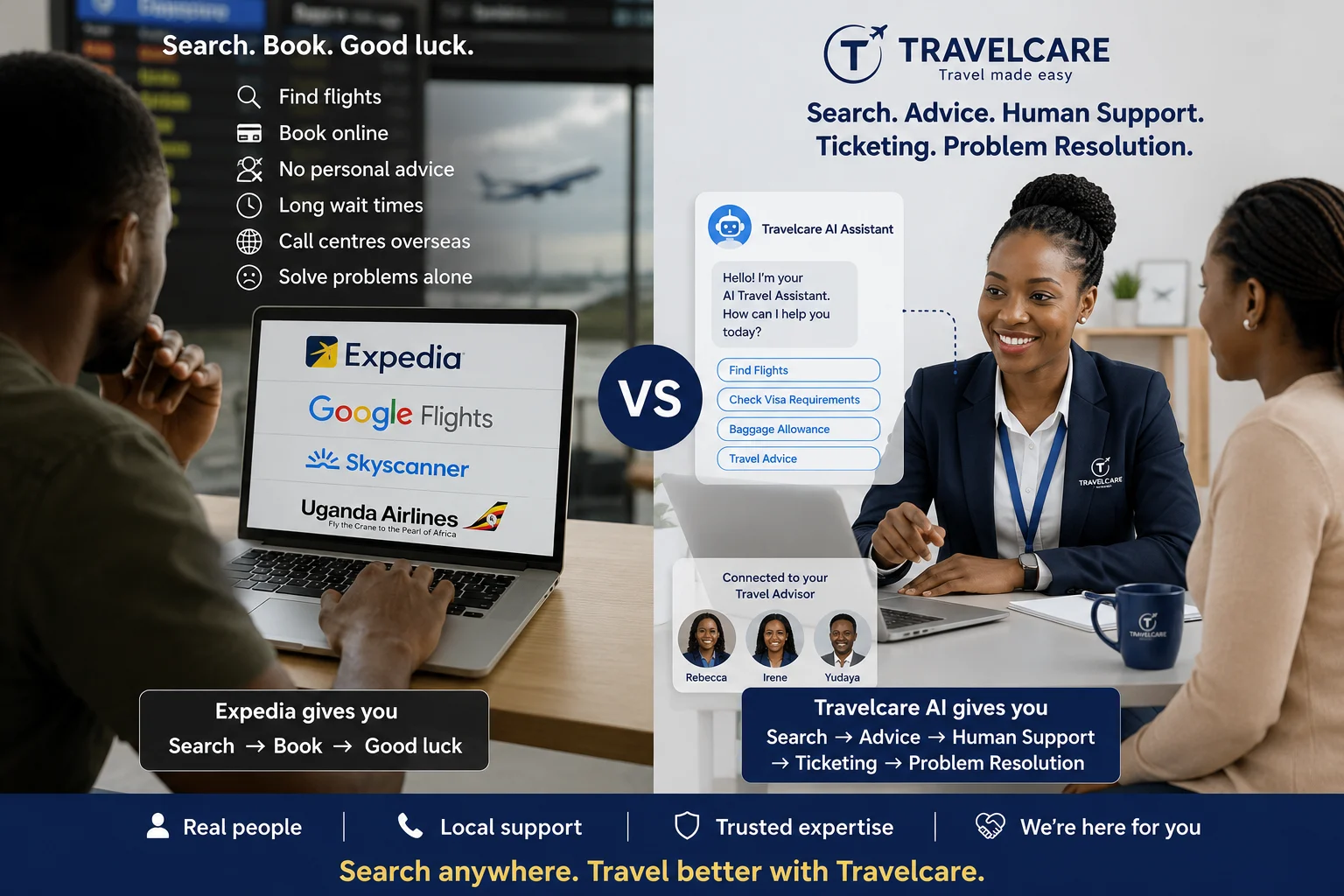
Expedia vs AI Travel Assistant Uganda: What’s the Real Difference?
At first glance, it’s easy to assume there’s very little difference between Expedia, Google Flights, airline websites, and an AI travel assistant Uganda. After all, if you search for an Entebbe–Nairobi return flight on each platform, the available airlines, departure times, and fares will often look remarkably similar. That’s because most reputable travel platforms access the same airline inventory through global distribution systems (GDS) or directly from airlines.
But that’s where the similarity ends.
The biggest difference isn’t what you see it’s what happens next.
Online booking platforms are built primarily for self-service. They help customers search, compare, and pay. Once the booking is complete, you’re largely responsible for managing your trip. If your plans change, your flight is cancelled, or you need advice on ticket conditions, you’re expected to navigate online help centres, automated chatbots, or overseas call centres.
An AI travel assistant Uganda backed by Travelcare takes a different approach. The AI isn’t designed to replace human expertise it’s designed to make it easier to access. Instead of ending the customer journey after displaying flights, it acts as the first point of contact before handing the enquiry to an experienced travel consultant.
Here’s the difference:
| Feature | Online Booking Engines | Travelcare AI Travel Assistant Uganda |
|---|---|---|
| Flight search | ✔ | ✔ |
| Fare comparison | ✔ | ✔ |
| Travel advice | Limited | ✔ Personalized guidance |
| Human travel consultant | Usually unavailable | ✔ Yes |
| Ticketing support | Self-service | ✔ Dedicated assistance |
| Flight changes | Online requests | ✔ Managed by consultants |
| Emergency assistance | Limited | ✔ Real people you can contact |
| Corporate travel support | Minimal | ✔ Comprehensive travel management |
The distinction becomes even more valuable for corporate travelers. Businesses don’t simply need tickets—they need travel policies, reporting, traveler tracking, flexible ticket management, and someone who can respond quickly when disruptions occur.
That’s why Travelcare’s AI travel assistant Uganda should never be positioned as “another Expedia.” Instead, it should be presented as the fastest way to begin a professionally managed travel experience. The AI simplifies the search, while experienced consultants provide the judgment, reassurance, and accountability that technology alone cannot offer.
What Happens When Your Flight Gets Cancelled?
A cancelled flight is one of the clearest examples of why booking a ticket and managing travel are two very different things. It’s also the moment when travelers discover the true value of the company they booked through.
Imagine you’ve booked an international trip online because the fare was slightly cheaper. A few hours before departure, your airline sends an email informing you that your flight has been cancelled due to operational reasons.
What happens next?
For many travelers using self-service booking platforms, the process can become frustrating:
- Searching for customer support numbers.
- Waiting on hold for extended periods.
- Explaining the situation to multiple agents.
- Navigating automated chat systems.
- Trying to understand airline policies while under pressure.
Meanwhile, meetings are missed, hotel bookings become uncertain, and onward connections may also be affected.
Now compare that experience with a traveler who used the AI travel assistant Uganda through Travelcare.
The traveler begins by asking the AI about available flights. After reviewing the options, the enquiry is passed to a Travelcare consultant who issues the ticket and remains associated with the booking. When the airline announces a cancellation, the traveler isn’t left searching for help they already know exactly who to contact.
Instead of calling an anonymous overseas contact centre, they reach someone who understands their itinerary and can immediately begin working on solutions. That could include rebooking on the next available service, identifying alternative routes, communicating with the airline, or advising on available options.
The experience changes from:
Problem → Search for help
to:
Problem → Contact someone who already knows your trip.
That’s a significant difference.
The goal of an AI travel assistant Uganda isn’t simply to make booking easier. It’s to make traveling less stressful when things don’t go according to plan. Technology speeds up the beginning of the journey, while experienced travel professionals provide confidence when circumstances change unexpectedly.
The Missing Piece: Human Travel Experts Still Matter
Artificial intelligence has transformed the way people search for travel, but it hasn’t replaced the need for human judgment. If anything, it has highlighted how valuable experienced travel consultants remain.
An AI travel assistant Uganda can process information quickly. It can compare fares, answer frequently asked questions, recommend flight options, and identify schedules that match your preferences. These are tasks that AI performs exceptionally well.
But travel isn’t only about data.
Travel involves uncertainty.
Consider situations like these:
- A traveler misses a connecting flight because of severe weather.
- A corporate executive needs to attend a meeting a day earlier than planned.
- A family has to cancel a holiday because of a medical emergency.
- A student receives a visa later than expected and must change departure dates.
These aren’t technical problems they’re human situations.
Resolving them often requires negotiation, experience, empathy, and practical knowledge of airline policies. Human consultants understand the nuances of ticket rules, relationships with airline partners, and the fastest way to find workable alternatives.
This is why the most effective AI travel assistant Uganda doesn’t attempt to replace travel advisors. Instead, it removes repetitive tasks so travel professionals can focus on higher-value conversations.
Think of AI as handling the questions that take seconds to answer, allowing experienced consultants to spend more time solving the questions that truly matter.
That partnership creates a better experience for travelers because they benefit from both speed and expertise.
Why AI Should Connect You to a Travel Advisor Not Replace One
There’s a growing misconception that artificial intelligence will eventually replace travel consultants entirely. While AI will undoubtedly continue to improve, travel is ultimately a people-focused industry.
A successful journey involves more than booking a seat on an aircraft.
Travelers often need reassurance.
They need advice.
They need someone who understands their priorities.
The strongest model isn’t AI instead of people.
It’s AI working with people.
That’s the philosophy behind an AI travel assistant Uganda that serves as a gateway rather than a destination. The AI gathers information, answers initial questions, and identifies suitable travel options. Once the traveler is ready to proceed or encounters a more complex question the conversation naturally moves to a qualified travel advisor.
This creates a seamless experience where technology and human expertise complement each other.
The customer doesn’t have to choose between convenience and service.
They receive both.
This approach is particularly valuable for:
- Corporate travel managers.
- Frequent business travelers.
- Families planning international holidays.
- Students traveling abroad.
- Travelers with complex itineraries.
Rather than removing the human relationship, AI strengthens it by making it easier for travelers to reach the right expert at the right time.
How Travelcare Combines AI With Real Travel Management
Travelcare’s vision for an AI travel assistant Uganda isn’t based on replacing travel consultants with software.
It’s based on creating a better customer journey.
That journey looks something like this:
- Search – The traveler asks the AI about flights, destinations, schedules, or travel requirements.
- Advice – The AI helps explain available options and highlights important differences between fares.
- Human Consultation – A Travelcare consultant reviews the enquiry, answers specific questions, and recommends the most suitable itinerary.
- Ticketing – The booking is completed professionally with clear explanations of ticket conditions and airline policies.
- Ongoing Support – If plans change before or during the trip, experienced consultants remain available to assist.
This model recognizes a simple truth:
People don’t actually want AI.
They want confidence.
AI happens to be an excellent tool for delivering that confidence faster but only when it’s supported by real people who remain accountable throughout the journey.
Travelcare’s approach combines the efficiency of technology with the reassurance of experienced travel professionals.
For travelers looking for more than just a booking engine, that’s a meaningful difference.
To learn more about Travelcare’s air ticketing and travel management services, visit:
👉 https://www.travelcare.ug/air-tickets-in-uganda/
Corporate Travelers Need More Than Flight Search
For corporate travelers, booking a flight is only one small part of a much larger process. Businesses need reliability, accountability, and visibility throughout every trip. While almost any booking platform can display available flights, few can support an organization before, during, and after travel. That is where an AI travel assistant Uganda backed by professional travel management becomes invaluable.
Imagine a company sending employees to Nairobi for a regional conference, Johannesburg for client meetings, or Dubai for supplier negotiations. The objective isn’t simply to find the cheapest fare. The business also needs to ensure employees arrive on time, comply with company travel policies, manage travel budgets, and receive immediate assistance if schedules change.
A standalone booking website isn’t designed to provide that level of support. Once the booking is confirmed, responsibility largely shifts to the traveler. For organizations managing dozens or even hundreds of trips each year, that approach creates unnecessary administrative work and potential risk.
An AI travel assistant Uganda integrated with a Travel Management Company (TMC) simplifies this process. The AI can quickly identify suitable flight options based on company preferences, preferred airlines, budget limits, or travel policies. Once the employee selects an option, experienced consultants take over, ensuring bookings comply with corporate requirements while remaining available if adjustments are needed.
Corporate travel management also extends beyond ticketing. Businesses often require:
- Centralized travel reporting.
- Spend analysis.
- Flexible ticket management.
- Traveler tracking during disruptions.
- Consolidated invoicing.
- Emergency travel assistance.
These services cannot be fully automated because they involve business relationships, decision-making, and personalized support.
For many organizations, the greatest value isn’t saving a few dollars on a ticket. It’s knowing that when a flight is delayed, a meeting changes, or a traveler needs immediate help, someone is already working on a solution. That combination of intelligent technology and dedicated human support transforms travel from a transaction into a managed business service.
Why Retail Travelers Benefit Just as Much
It’s easy to assume that managed travel is only for large corporations, but retail travelers often face the same challenges and sometimes even greater uncertainty. Families, students, honeymooners, first-time international travelers, and individuals visiting relatives abroad all benefit from guidance that extends beyond the booking process. An AI travel assistant Uganda makes travel planning simpler, but the addition of human expertise makes it significantly more reassuring.
Consider a family planning their first holiday outside Uganda. They may have questions about baggage allowances, connecting flights, travel insurance, airport transfers, or visa requirements. A booking engine can display prices, but it rarely explains which option is actually the best fit for that family’s needs.
The same applies to students heading overseas for university. Their journeys often involve multiple connections, generous baggage requirements, flexible tickets, and documentation deadlines. Having access to both intelligent search tools and experienced travel consultants reduces stress at every stage of the journey.
Retail travelers also face unexpected events. Flights are rescheduled, family emergencies occur, weather disrupts travel plans, or airlines introduce operational changes. When these situations arise, the ability to contact someone who understands the booking can make all the difference.
This is where the AI travel assistant Uganda becomes much more than a digital assistant. It serves as the first point of contact, helping travelers find suitable options quickly before connecting them with professionals who remain available throughout the journey.
Rather than leaving travelers to solve problems on their own, Travelcare combines AI efficiency with personal service. That approach creates confidence, especially for travelers who value knowing that expert assistance is only a phone call or email away.
The Future of AI Travel Assistant Uganda
Artificial intelligence will continue to reshape the travel industry over the coming years, but its greatest contribution may not be replacing travel professionals. Instead, it will make travel advice faster, more personalized, and easier to access. The future of the AI travel assistant Uganda lies in collaboration rather than competition.
As AI evolves, travelers can expect even more intelligent recommendations based on travel history, personal preferences, airline loyalty programs, seasonal pricing, and real-time schedule changes. Rather than manually comparing dozens of flights, AI will increasingly anticipate traveler needs and present tailored options almost instantly.
Future capabilities may include:
- Predicting fare changes before they happen.
- Recommending the best time to book.
- Monitoring flights for disruptions.
- Suggesting alternative routes automatically.
- Providing destination-specific travel information.
- Integrating travel documents and itineraries into one seamless experience.
However, even the most advanced AI cannot replace the trust that develops between travelers and experienced advisors. Travel often involves important life moments business opportunities, family reunions, educational milestones, and once-in-a-lifetime holidays. These situations require empathy, judgment, and accountability alongside technology.
That is why the future isn’t about choosing between AI and people. It is about combining both strengths to create a better customer experience.
For travelers in Uganda, this hybrid model offers the best of both worlds: instant access to information through an AI travel assistant Uganda, supported by knowledgeable travel professionals who remain available when expert advice is needed most.
Why Travelcare’s Approach Is Different
Many companies can help you search for flights. Many websites can compare fares in seconds. Airline websites, metasearch engines, and online travel agencies all perform that function extremely well.
Travelcare isn’t trying to compete by claiming access to different flight information. Instead, its approach focuses on what matters after the search.
The Travelcare experience follows a simple but powerful journey:
Search → Advice → Human Support → Ticketing → Problem Resolution
That sequence reflects the reality of modern travel. Finding flights has become easy. Managing travel well remains difficult.
With the AI travel assistant Uganda, travelers receive immediate assistance during the discovery stage. They can ask questions naturally, compare options, and better understand available choices. When the conversation becomes more complex, experienced consultants step in to provide practical guidance and ongoing support.
This model recognizes that technology is most effective when it enhances relationships rather than replacing them.
For businesses, it means managed travel backed by real experts.
For leisure travelers, it means confidence before, during, and after every journey.
Whether you’re planning a short regional trip or a long-haul international itinerary, Travelcare combines digital convenience with professional travel management to deliver a more complete travel experience.
Learn more about Travelcare’s travel services here:
👉 https://www.travelcare.ug/air-tickets-in-uganda/
Conclusion
Artificial intelligence has changed how we search for travel, but it hasn’t changed what travelers value most: confidence, reliability, and genuine support. An AI travel assistant Uganda makes it easier to compare flights, ask questions, and begin planning a journey in seconds. Yet the true value of travel lies not in the search itself, but in the support available when plans change or unexpected situations arise.
That is the difference between a booking platform and a travel management partner.
Booking engines are excellent at helping customers find flights. Travelcare goes further by combining intelligent technology with experienced travel consultants who remain available throughout the journey. From expert advice and ticketing to itinerary changes and problem resolution, travelers receive assistance that extends well beyond the initial booking.
As AI continues to evolve, the strongest travel experiences will come from combining the speed of technology with the judgment and care of real people. The future of travel isn’t AI alone it is AI working alongside trusted travel professionals.
When choosing how to book your next trip, perhaps the most important question isn’t “Who can show me flights?”
It’s “Who will help me when I need them most?”
That is where an AI travel assistant Uganda backed by Travelcare delivers lasting value.
Frequently Asked Questions
1. Is an AI travel assistant Uganda different from Expedia or Google Flights?
Yes. While flight information is often similar, an AI travel assistant Uganda backed by Travelcare goes beyond search by connecting travelers with experienced consultants who provide advice, ticketing assistance, and ongoing travel support.
2. Can an AI travel assistant book flights for me?
An AI travel assistant can help you find and compare flight options quickly. Through Travelcare, the booking process is supported by experienced travel professionals who ensure your itinerary meets your needs and provide assistance if changes arise.
3. What happens if my flight is cancelled after booking?
If your booking is managed through Travelcare, you have access to real travel consultants who can help with rebooking, itinerary adjustments, and airline communication. This level of support is often unavailable through self-service booking platforms.
4. Is Travelcare’s AI useful for corporate travel?
Absolutely. Businesses benefit from faster trip planning, policy-compliant recommendations, dedicated account support, reporting, and professional travel management that extends beyond simply issuing tickets.
5. Why should I use an AI travel assistant instead of booking directly with an airline?
Booking directly with an airline works well for straightforward trips. However, an AI travel assistant Uganda supported by Travelcare provides expert advice, human assistance, and ongoing travel management offering peace of mind if plans change before or during your journey.
Planning a trip? Travelcare can help.
Flights, hotels, transfers, insurance & visas — one invoice, one advisor.