
Table of Contents
Uganda has a way of turning one travel idea into an entire adventure. You might start by dreaming about seeing mountain gorillas, then find yourself imagining elephants on safari, Murchison Falls, Lake Bunyonyi, Kampala’s food and culture, or a few quiet days surrounded by nature. That is where tourism and ai in uganda becomes more than a technology topic. It becomes a practical question: how can technology help you turn an exciting idea into a trip that actually works?
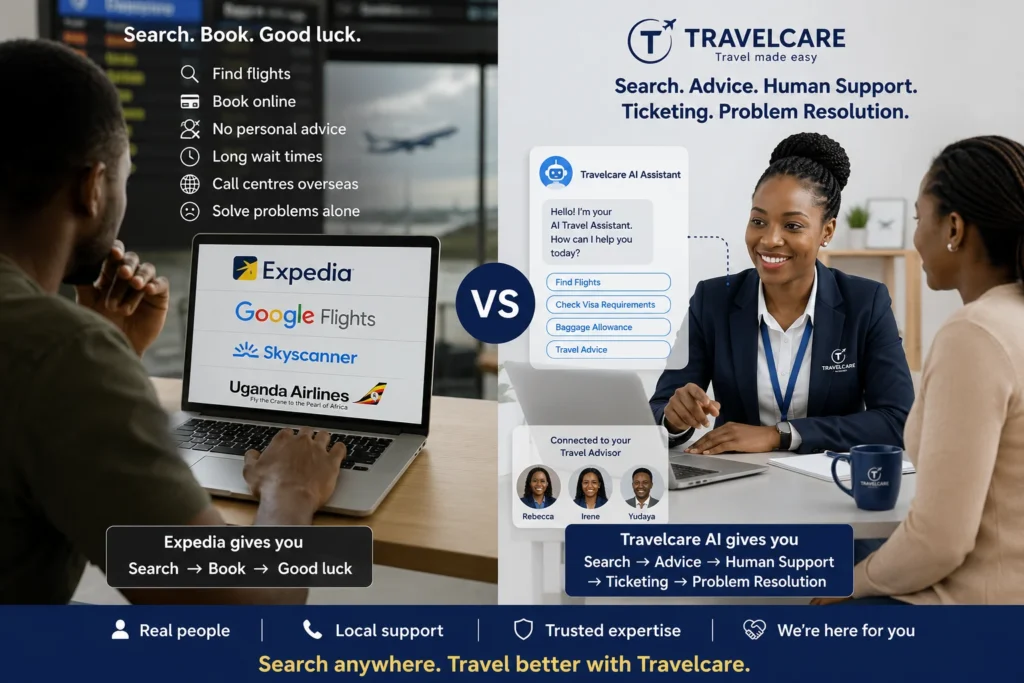
Today, tourism and ai in uganda is creating new ways for travelers to research destinations, organize their preferences, compare travel choices, and get help when they need it. Travelcare’s Zavi is built around one particularly useful part of that journey. You can chat with Zavi about your flight needs, answer a few simple questions, compare real flight options, and then connect with a real Travelcare advisor when you are ready to book.
The idea is simple. You should not need to spend hours jumping between airline websites just to get started. With tourism and ai in uganda, the technology can handle some of the repetitive early work while human travel professionals remain available for the decisions and situations that need personal attention.
Uganda remains the star of the story. AI simply helps make the road from inspiration to travel a little easier.
Why Tourism and AI in Uganda Are Coming Together
The way people plan holidays has changed. A traveler can discover Uganda through a social media post in the morning and be searching for flights by lunchtime. The problem is that inspiration is easy, while practical planning can become complicated very quickly. Once you move from “I want to visit Uganda” to “I need a flight from London for two adults in November,” you suddenly have dates, airlines, connections, baggage questions, prices, schedules, and other details to consider.
That is one reason tourism and ai in uganda is becoming an interesting part of modern travel. Conversational AI allows you to explain what you want in normal language rather than forcing you to understand complicated search forms. You can start with a rough idea, answer questions as they come up, and gradually turn that idea into a clearer travel request.
Think of it like having a travel notebook that can talk back. You write down the important pieces of your journey, and the assistant helps you organize them. For a visitor coming to Uganda, that can be useful because the country offers such a wide range of experiences. Your trip could be focused on wildlife, gorilla trekking, family visits, culture, business, relaxation, or a mixture of several things.
The real value of tourism and ai in uganda is therefore not simply having an AI chatbot. It is using technology to solve a genuine travel problem. If AI saves you time while helping you find relevant flight choices and then gives you access to a real advisor, it has a clear purpose.
Uganda Has More Than One Kind of Holiday
There is no single Uganda holiday. A honeymoon couple may want a completely different experience from a family with children. A wildlife photographer may prioritize national parks, while a diaspora traveler may spend most of the trip visiting relatives and add a safari at the end. A first-time international visitor may want to combine several destinations, while another traveler may prefer to stay in one area and explore slowly.
This variety makes tourism and ai in uganda especially useful as a planning concept. The technology does not need to tell everyone to follow the same itinerary. Instead, it can help you explain your own priorities. What matters most to you? Are you trying to save time, find a convenient flight, travel with children, avoid long connections, or arrive at a particular time?
Zavi follows this conversational approach. It asks questions one at a time so it can understand your journey instead of immediately assuming details. It can ask where you are traveling from, where you want to go, your dates, how many people are traveling, children’s ages when relevant, your cabin preference, and whether you need a one-way, round-trip, or multi-city journey.
That makes tourism and ai in uganda practical rather than abstract. You are not using AI just because it is fashionable. You are using it because describing your trip in a conversation can be easier than working through a complicated search process alone.
What Tourism AI Means for a Trip to Uganda
The phrase tourism AI can sound like something designed only for airlines, hotels, or large tourism companies. For travelers, it is much simpler. Tourism and ai in uganda can involve using artificial intelligence to discover information, organize travel preferences, compare choices, answer common questions, and make it easier to reach the right human professional.
That distinction matters. There is plenty of excitement around artificial intelligence, but travelers usually have much more practical questions. Can I find a flight without checking ten websites? Can I compare different options quickly? Can I change my search if my dates move? Can someone help me when my request is complicated?
A useful approach to tourism and ai in uganda should answer those questions rather than simply produce impressive-sounding AI content. For Zavi, the main purpose is flight search. You tell Zavi what you need, it asks for the details required to search properly, and it shows available options with real prices and times. You can then compare those choices and decide what works for you.
Zavi does not pretend that AI should manage every part of your holiday. That is important because travel is personal. A computer can help organize information, but a real person can understand a complicated situation, ask follow-up questions, and provide reassurance when a traveler needs it.
From Travel Inspiration to a Real Flight
Imagine discovering a photograph of gorillas in Bwindi and thinking, “I have to see this.” The inspiration is instant. The practical planning is not. Suddenly you need to think about when to travel, how to reach Uganda, how long to stay, how the safari fits into the trip, and what flight schedule makes sense.
This is where tourism and ai in uganda can bridge the gap between dreaming and doing. Instead of opening one airline website after another, you can start by explaining your travel needs. Zavi can then ask the questions required to understand the flight request.
The process can be particularly useful for international travelers who are unfamiliar with the available routes into Uganda. Rather than trying to remember every possible airline and schedule, you can have a conversation and compare relevant choices. Zavi can present up to five visual flight cards with real prices and times, helping you focus on the options that matter.
The goal of tourism and ai in uganda is not to take control of your holiday. It is to remove unnecessary friction. You still decide where you want to go, when you want to travel, and which option you prefer. Zavi simply helps you get from a rough travel idea to a useful flight search more quickly.
Discovering Uganda’s Best Tourism Experiences
Uganda’s tourism appeal comes from its variety. The country offers wildlife, primates, forests, mountains, lakes, rivers, cultural experiences, and vibrant urban life. A visitor might combine a wildlife safari with gorilla trekking, while another traveler may focus on culture and family. Someone with more time can explore several regions, while a shorter visit may require much more careful prioritization.
For travelers researching destinations, Visit Uganda is a useful starting point for learning more about the country. Resources like this remain important even as tourism and ai in uganda develops. AI should help organize your questions and planning process, not replace reliable destination information.
The same principle applies to tourism operators and travel advisors. The technology can help a traveler move faster, but local knowledge remains extremely valuable. A destination is not simply a collection of attractions on a map. Travel time, seasonal conditions, permits, transfers, accommodation, and personal preferences all affect the experience.
That is why tourism and ai in uganda works best when it supports good travel planning instead of pretending to replace it.
Safaris, Wildlife and National Parks
For many international visitors, Uganda’s wildlife is the reason for the journey. The country offers opportunities to experience elephants, lions, hippos, buffalo, giraffes, chimpanzees, birds, and other wildlife depending on the destination and season. National parks are not interchangeable, though. Each has its own character and offers different experiences.
Someone interested in classic game viewing may have different priorities from a birdwatcher. A photographer may want a completely different schedule from a family traveling with young children. A traveler with ten days can consider more possibilities than someone with four days.
This is where tourism and ai in uganda can help during the early planning stage. You can describe the kind of experience you want and use that information to identify questions worth asking a destination specialist. AI can help structure the conversation, while human tourism professionals can provide deeper local guidance.
Zavi’s role is more specific. It helps with the flight portion of your journey. Once your travel dates and other flight requirements are clear, Zavi can search and compare available options. That creates a useful connection between the destination you are excited about and the transportation you need to get there.
Gorilla Trekking and Forest Adventures
Gorilla trekking is one of Uganda’s most memorable tourism experiences, but it is also an example of why responsible planning matters. A forest adventure involves more than buying an airline ticket. Travelers need to think about permits, accommodation, transportation, physical readiness, timing, and other practical details.
The role of tourism and ai in uganda should be supportive rather than overconfident in situations like this. AI should not invent permit availability or guarantee that a particular wildlife encounter will happen. It should not replace official information or experienced local professionals.
What it can do is help you organize the travel side of the journey. If you know when you want to travel, where you are flying from, and who is traveling with you, Zavi can help search for suitable flight options. If your request becomes complicated, a Travelcare advisor can step in.
This combination shows where tourism and ai in uganda can be genuinely useful. Technology handles speed and organization, while people remain involved where expertise, judgment, and current destination knowledge are important.
Using AI to Build a More Practical Uganda Trip
A good holiday is not necessarily the one with the longest list of attractions. It is the one that gives you enough time to enjoy what you came to see. A traveler who tries to squeeze five destinations into a short visit may spend more time sitting in vehicles than enjoying Uganda.
This is another area where tourism and ai in uganda can support better decisions. Before looking for flights, you can think about what matters most. Is gorilla trekking the main purpose? Is the safari the priority? Are you returning home to visit family? Do you have a fixed event such as a wedding or conference?
Once those priorities are clear, flight planning becomes easier. Zavi can work from the practical details of your request instead of showing random options.
Matching Destinations With Your Travel Style
Your travel style affects almost every decision. A backpacker may be comfortable with more flexibility, while a family may want convenient schedules. A honeymoon couple may value comfort, while a business traveler may prioritize arrival times. A large group may need additional coordination that a simple search cannot handle.
The strength of tourism and ai in uganda is its ability to start with conversation. You can explain your situation rather than trying to translate your needs into technical filters. Zavi can then ask the questions required for a relevant flight search.
That does not mean AI chooses your trip for you. It means the technology helps you communicate your requirements more clearly. The final choice remains yours, and a human Travelcare advisor can help when you need personal assistance.
How Zavi Helps With Flight Planning
This is where tourism and ai in uganda connects directly with Travelcare’s Zavi. Zavi is an AI chat assistant designed to help travelers search and compare flights. You can start chatting through the Travelcare website or an embedded Zavi experience without needing to create an account just to begin your search.
Instead of asking you to fill out a complicated form immediately, Zavi asks questions conversationally. It confirms your origin, destination, dates, travelers, children’s ages where applicable, cabin class, and journey type.
This approach makes tourism and ai in uganda easier for travelers who may not know exactly what information matters. You can simply explain the trip and let the conversation guide you toward the details required for the search.
Searching and Comparing Real Flight Options
Once Zavi understands the request, it searches and presents real flight options. It can show up to five visual flight cards containing real prices and times. That matters because travelers need actual choices, not invented or estimated fares.
For shorter East African routes, Zavi can prioritize direct flights when appropriate, particularly for journeys such as Entebbe to Nairobi, Kigali, or Dar es Salaam. If you are comfortable with a connection, you can say so. For routes that Uganda Airlines serves directly from Entebbe, Zavi can also check and fairly surface that option.
This is a practical example of tourism and ai in uganda at work. Instead of making the traveler search across different sites, the assistant brings relevant options into one conversation.
When you are ready to book, Zavi does not pretend to be a fully automated checkout system. It collects the necessary contact information and connects you with a real Travelcare advisor. The advisor can then finalize the booking and help with questions that require human attention.
Why Flight Timing Matters on a Uganda Safari
A flight is part of your wider holiday, not a separate event. Arrival time can affect transfers, hotel check-in, rest, and the beginning of your adventure. The cheapest flight is not automatically the best flight if its schedule creates unnecessary complications.
This is another reason tourism and ai in uganda should be considered as a planning tool rather than just an automated ticket search. Your flight preferences should reflect the rest of your journey. If you are traveling with children, for example, you may value a manageable schedule. If you are connecting directly to a safari transfer, timing may matter even more.
Zavi helps by giving you a conversational way to explain those preferences. You can compare flight options based on your requirements and then discuss the preferred option with a Travelcare advisor.
The technology does not need to know everything about your safari. It needs to help you find the flight options that fit the information you provide.
Tourism and AI in Uganda for International Visitors
International visitors often face more planning questions than someone who already knows the country. They may be researching Uganda for the first time while also trying to understand flights, entry requirements, local transport, accommodation, currency, weather, and regional travel.
This is where tourism and ai in uganda can make the research process feel less scattered. Instead of treating every question as a separate search, travelers can use conversational tools to organize what they already know and identify what still needs confirmation.
Zavi can help with the flight portion of this process. It can also provide information about visa and entry requirements using current available information, while reminding travelers to confirm important requirements with an advisor or official source before booking.
That final verification is important. Immigration and entry rules can change. Responsible tourism and ai in uganda should make travelers more informed, not give them false confidence based on outdated information.
Tourism AI for Diaspora Travelers Returning Home
Uganda’s diaspora community represents another important group of travelers. Returning home may involve visiting family, attending weddings, handling business, reconnecting with friends, or adding a holiday to the trip.
A diaspora traveler might know Uganda extremely well and still want help finding the right flight. Knowing the destination does not necessarily make international flight schedules, fares, connections, and cabin choices easier to compare.
This is another practical application of tourism and ai in uganda. A traveler can explain the trip in ordinary language and then let Zavi work through the flight requirements. If the dates change, the traveler can adjust the request. If more family members join the trip, those details can be included.
The technology becomes a useful starting point without pretending to replace the Travelcare advisor who can help finalize the booking.
Planning Family and Group Trips With Zavi
Family travel can turn a simple flight search into a complicated puzzle. Adults and children may have different fare requirements, schedules may need to work for everyone, and larger groups can require additional coordination.
Tourism and ai in uganda can help simplify the first stage by making it easier to communicate the details. Zavi asks about the number of travelers and children’s ages where relevant. That gives the flight search more context.
Large groups may require a custom quote or additional attention. School groups, wedding parties, corporate teams, and extended family trips are good examples. In those situations, the best use of AI is recognizing when a human advisor should become involved.
This is why Zavi is designed around human handoff. Tourism and ai in uganda does not have to mean automation at every stage. Sometimes the smartest next step is getting a real person involved quickly.
Using AI to Think Through Visa and Entry Questions
Visa and entry requirements can be one of the least exciting parts of planning a holiday, but they are too important to ignore. Travelers need to know what applies to their nationality and situation, and they should verify current requirements before traveling.
AI can make this research easier by helping travelers identify the questions they need to answer. Within tourism and ai in uganda, tools such as Zavi can provide available information and remind travelers to confirm critical requirements before making final decisions.
For anything involving immigration, passports, visas, health requirements, or border rules, official sources should remain the final reference. AI can help you understand what to investigate, but it should not be treated as an immigration authority.
Used responsibly, tourism and ai in uganda can reduce confusion without encouraging travelers to skip proper verification.
Where Human Travel Advisors Still Matter
One of the biggest misunderstandings about AI is the idea that every travel interaction should eventually become fully automated. Travel does not work that way. Some trips are simple, while others involve multiple travelers, unusual routing, special cabin requests, changing dates, or personal circumstances.
That is why tourism and ai in uganda works particularly well when AI and human support are combined. Zavi can handle the early conversation, gather flight requirements, search options, and help you compare them. A real Travelcare advisor then takes over when you are ready to book.
If you need First Class or Premium Economy, have a multi-city request, are arranging a large group, or simply want to speak with someone before finalizing the booking, human support becomes valuable.
AI provides speed. Real advisors provide human support. That is not a compromise. For many travelers, it is the better model.
Tourism and Artificial Intelligence Without Losing the Human Touch
Travel is fundamentally human. People travel to see family, experience nature, celebrate important moments, learn about cultures, relax, explore, and create memories. No algorithm can replace the emotional reason behind a journey.
The best tourism and ai in uganda solutions should therefore make travel feel easier, not colder. You should be able to ask a question naturally, explain your situation, and receive useful help without feeling like you are talking to a machine that only understands dropdown menus.
Zavi is designed with that balance in mind. It provides a simple conversational starting point, helps search and compare real flight options, and then brings a real Travelcare advisor into the process when appropriate.
That human handoff is an important part of the Travelcare approach to tourism and ai in uganda. The technology does not need to replace relationships. It can help create more time for the relationships that matter.
A Simple Example: Planning a Uganda Safari With Zavi
Imagine a couple living in Canada who have decided to visit Uganda for ten days. They want to see gorillas, experience a safari, and spend some time in Kampala. They know roughly when they want to travel, but they have not yet decided which flight is best.
They begin by exploring Uganda’s tourism experiences. As they narrow down their plans, they use Zavi to search for flights. This is a practical example of tourism and ai in uganda because the technology is being used to connect a destination dream with an actual transportation decision.
Zavi asks where they are flying from, their dates, number of travelers, cabin preference, and journey type. It searches the available options and presents real prices and times. The couple can compare the choices and decide which one better fits their preferences.
Perhaps they initially choose a particular date and later realize they need an extra day. They can update the request rather than starting from scratch. Perhaps they decide that a more convenient schedule is worth paying slightly more for. The conversation helps them focus on the trade-off.
Once they are ready, Zavi connects them with a Travelcare advisor. The advisor can then finalize the booking and help with any questions that need personal attention.
That is a straightforward example of tourism and ai in uganda doing something useful. It does not magically plan an entire safari. It makes the flight-planning stage easier while keeping a human professional involved.
AI and Responsible Tourism in Uganda
Uganda’s tourism resources are valuable. Gorillas, forests, national parks, lakes, wildlife, cultural heritage, and local communities deserve respect. Technology should support responsible tourism rather than encouraging travelers to treat destinations like items on a checklist.
Responsible tourism and ai in uganda means using AI carefully. Travelers should verify important information, respect local rules, follow conservation guidance, and choose legitimate tourism services. AI should not invent facts about wildlife, promise guaranteed sightings, or provide false certainty about conditions.
Travelers can learn more about Uganda through Visit Uganda. For broader information about sustainable tourism and global tourism development, UN Tourism is also a useful resource.
The role of tourism and ai in uganda should be to make better planning possible while keeping the destination and the people who live there at the center of the experience.
What Tourism and AI in Uganda Could Look Like Next
The future of tourism and ai in uganda is likely to become increasingly conversational. Travelers are already becoming comfortable asking technology questions in ordinary language. Instead of searching through multiple pages, they can explain what they want and expect a useful response.
For Uganda, this creates an opportunity to make travel planning more accessible to international visitors and diaspora travelers. Someone researching the country from thousands of kilometers away can start asking questions without needing to understand the local travel market immediately.
But the future of tourism and ai in uganda should not be about adding AI everywhere simply for the sake of saying that a business uses artificial intelligence. The technology needs a job. If it helps travelers find relevant flights faster, compare choices, and connect with the right person, it has a clear purpose.
The strongest model will likely combine AI’s speed with human expertise. That is exactly where Zavi fits.
Why Travelcare Built Zavi for Uganda Travel
Travelcare built Zavi to solve a practical problem: finding and comparing flights can take too much time. Travelers may have to check different websites, compare schedules, revisit searches when dates change, and still wonder whether they have found the right option.
Zavi provides a conversational alternative. You can tell it what you need, answer a few questions, and receive real flight options. It can recommend an option based on the information you provide and explain why it may fit your request.
This makes Zavi a practical example of tourism and ai in uganda rather than an abstract technology experiment. The technology is connected to a real travel task. It helps people move from wanting to travel to having flight options they can actually consider.
When you are ready, Zavi connects you with a real Travelcare advisor. That human step is central to the experience.
You can learn more about the broader Travelcare approach on the AI Travel Advisor in Uganda pillar page. It explains how Zavi combines conversational AI, flight search, recommendations, and human travel support.
How to Start Planning Your Uganda Trip With Zavi
You do not need a perfectly written travel plan before opening a conversation with Zavi. Start with what you know. Maybe you know your departure city and approximate dates. Maybe you already know that gorilla trekking is the main reason for your trip. Maybe you are returning to Uganda for a family event and want to add a few days of tourism.
This is where tourism and ai in uganda becomes practical for ordinary travelers. Instead of worrying about whether you have entered every detail correctly, you can start a conversation and work through the missing information.
A simple process looks like this:
- Tell Zavi where you are flying from and where you want to go.
- Confirm your travel dates and journey type.
- Add the number of travelers and children’s ages where applicable.
- Tell Zavi your preferred cabin class and important flight preferences.
- Compare the available real flight options.
- Choose the option that best fits your needs.
- Connect with a real Travelcare advisor to finalize the booking.
The important thing is that tourism and ai in uganda should serve your travel goals rather than dictate them. You choose the safari. You choose the destination. You decide what kind of experience you want. Zavi helps make the practical flight-planning part easier.
Conclusion: Tourism and AI in Uganda Can Make Travel Simpler
Tourism and ai in uganda is not just about putting artificial intelligence into tourism websites. At its best, it is about solving real problems for real travelers. Uganda already has extraordinary destinations and experiences. The opportunity is to make the journey from discovering those experiences to planning the trip less complicated.
For an international visitor, tourism and ai in uganda can help turn destination inspiration into practical travel questions. For a diaspora traveler, it can make finding and comparing flights easier when returning home. For families and groups, it can provide a conversational way to communicate important travel details.
Travelcare’s Zavi brings this idea into the flight-booking journey. It asks questions, searches real flight options, compares choices, makes recommendations, and connects travelers with a real Travelcare advisor when they are ready to book.
That is the important part of tourism and ai in uganda. AI does not have to replace the human side of travel to be useful. It can provide speed, organization, and convenience while experienced advisors remain available for complicated requests and important booking decisions.
Uganda’s forests, wildlife, national parks, culture, lakes, and communities are what make the journey worth taking. Technology is simply another tool that can help travelers get there.
For the traveler sitting somewhere in the world thinking, “Maybe this is the year I finally visit Uganda,” tourism and ai in uganda can help turn that thought into a practical first step.
FAQs About Tourism and AI in Uganda
Q: What does tourism and ai in uganda mean for travelers?
A: Tourism and ai in uganda means using artificial intelligence to make parts of the travel process easier, such as researching options, organizing preferences, and searching for flights. Zavi applies this idea to flight planning by helping travelers compare real options before connecting them with a Travelcare advisor to finalize the booking.
Q: How can tourism and ai in uganda help me plan a safari?
A: Tourism and ai in uganda can help with the early planning process by helping you organize your travel preferences and transportation needs. Zavi is particularly useful for finding and comparing flights. Safari permits, accommodation, transfers, and destination-specific requirements should still be confirmed through appropriate tourism professionals and authoritative sources.
Q: Can tourism and ai in uganda help international visitors?
A: Yes. Tourism and ai in uganda can make planning easier for international visitors who may be unfamiliar with flight options and travel arrangements. Zavi can ask about your departure city, dates, travelers, cabin class, and journey type, then show real flight options. A Travelcare advisor can provide human assistance when you are ready to book.
Q: Is tourism and ai in uganda useful for Ugandans living abroad?
A: Tourism and ai in uganda can be particularly useful for diaspora travelers returning to Uganda for family visits, celebrations, business, or holidays. Zavi provides a conversational way to search and compare flights, which can save time when travelers are trying to balance fixed dates, family plans, and other commitments.
Q: Does Zavi replace a human Travelcare travel advisor?
A: No. Tourism and ai in uganda works best when AI and human expertise work together. Zavi helps with the initial conversation, flight search, comparison, and recommendation. When you are ready to book, it connects you with a real Travelcare advisor who can help finalize the booking and handle requests that require human attention.
Planning a trip? Travelcare can help.
Flights, hotels, transfers, insurance & visas — one invoice, one advisor.