
Table of Contents
Planning a trip can start with something as simple as, “I want to visit Uganda for five days.” Then the questions arrive. Which airport should you fly into? Which dates make sense? Should you stay in Entebbe, Kampala, Jinja, or somewhere farther away? Which flight is actually worth choosing? And once you find one, who helps you turn that choice into a real booking?
That is where an AI travel itinerary in Uganda can make the early part of the process much easier. Travelcare’s Zavi gives you a simple place to talk through your trip, search real flight options, compare them, and decide what makes sense before you connect with a real Travelcare advisor.
The idea is not to hand your entire holiday over to a machine. Think of Zavi more like a quick travel-planning companion at the front door. You explain what you are trying to do, Zavi helps organize the important details and find suitable flights, and a human advisor steps in when you are ready to book.
So, what does an AI travel itinerary in Uganda actually look like in practice? Let’s walk through one.
What Is an AI Travel Itinerary in Uganda?
An AI travel itinerary in Uganda is a structured travel plan created with help from artificial intelligence. Instead of keeping flight dates, destinations, activities, and travel questions scattered across different websites, you can bring the basic details of your trip together and work through them in one conversation. That can be especially useful when you are still figuring out the shape of your journey.
Imagine planning a trip with a friend who is very good at organizing details. You say, “I am travelling to Uganda for five days with my wife and two children.” The next questions become much easier to handle because someone is helping you turn that broad idea into specific travel requirements. You still make the decisions, but you do not have to start from a blank page.
With Zavi, the focus is particularly practical. It can ask about your departure point, destination, travel dates, number of travelers, children’s ages where relevant, cabin class, and whether you need a one-way, return, or more complex journey. It then helps search available flight options and presents real prices and timings rather than making up figures to fill a page.
That distinction matters. A beautiful itinerary is not very useful if the flight supporting it does not exist.
An AI travel itinerary in Uganda should therefore connect the dream of the trip with the practical side of getting there. You might have a perfect five-day plan in your notebook, but if your arrival time makes the first day impossible, the plan needs adjusting. Zavi helps bring those travel details into the conversation earlier.
How Zavi Fits Into Your Travel Plan
Zavi is not designed to replace a Travelcare advisor. Its role is to make the first part of the journey faster and easier.
You can start chatting without creating an account first. You explain what you want, answer a few questions, and Zavi helps narrow down your flight choices. When you are ready to move forward, you provide your contact details and Zavi connects you with a real Travelcare advisor who can take care of the booking process.
That creates a useful balance. AI handles the fast information-gathering and flight comparison, while a real person remains available when the decision becomes important.
For a traveler, that can remove a lot of unnecessary back-and-forth. You do not have to explain the same trip from scratch to different people after spending an hour searching online. The conversation begins with the requirements you have already discussed.
This is also why the phrase AI travel itinerary in Uganda should not be understood as “press a button and receive a fully automated holiday.” Travel is rarely that simple. Plans change. Families have different needs. A cheap flight might arrive at an inconvenient time. A nonstop flight might be worth paying a little more for. A complicated multi-city trip may need a person to look at the details.
Zavi helps you get closer to the right decision without pretending that every travel situation can be solved by automation.
Why Build an AI Travel Itinerary in Uganda?
The hardest part of planning a trip is often not finding information. There is plenty of it. The problem is figuring out which information matters to your trip.
Search “flights to Uganda” and you can quickly find yourself looking at dozens of pages. Search hotels, attractions, visa rules, airports, baggage allowances, and transport, and the number of tabs can become ridiculous. You might even reach the point where you have researched so much that you are less certain than when you started.
An AI travel itinerary in Uganda can help by putting the conversation around your actual trip rather than forcing you to search every question separately.
Suppose you are travelling from London to Uganda with your partner. You want to spend a few days seeing family in Kampala and then visit Jinja before flying home. Your first thought might simply be to search for the cheapest return ticket. But price is only one part of the decision.
What time does the flight arrive? How long do you have on the ground? Is the return date flexible? Are you checking luggage? Would a different departure time give you a more useful first day? If you are travelling with children, does the itinerary make the journey unnecessarily tiring?
These are the kinds of questions that make an itinerary useful.
From Travel Ideas to Real Flight Options
A good AI travel itinerary in Uganda starts with reality. That means knowing your dates, route, travelers, and preferences before jumping into recommendations.
Zavi asks those questions conversationally. You do not have to figure out which field to complete next. You simply answer the question in front of you.
Once the details are clear, Zavi can search for available flights and show up to five options with their real prices and times. It can then recommend an option and explain why it stands out.
That makes the itinerary process more practical. Instead of saying, “Here is a five-day Uganda itinerary,” without considering how you actually get to Uganda, the planning process can begin with the transportation that makes the trip possible.
The result is not necessarily a fixed schedule carved in stone. It is a working plan.
And that is often exactly what travelers need.
How Zavi Helps Build an AI Travel Itinerary in Uganda
The easiest way to understand an AI travel itinerary in Uganda is to follow the conversation from beginning to end.
You start with an idea. Perhaps you know where you are going but have not decided which flight to take. Perhaps you know the dates but are unsure whether a morning or evening departure is better. Or maybe you are travelling with your family and want to avoid unnecessary connections.
Zavi starts by understanding the trip rather than guessing.
Start With Your Actual Trip Details
The first step is getting the basics right.
Zavi can ask where you are travelling from, where you are going, your travel dates, how many people are travelling, and what type of cabin you want. If children are travelling, their ages can matter because fares and travel arrangements may differ.
This sounds straightforward, but it is one of the most important parts of an AI travel itinerary in Uganda. A recommendation is only useful if it is based on the correct trip.
For example, imagine two travelers both saying they want a flight to Uganda. One is travelling alone for a business meeting. The other is travelling with two young children for a family holiday. Their best options may look very different.
The business traveler might value an arrival time that gives them a full working day. The family might care more about a convenient schedule and avoiding a long overnight connection.
Zavi does not need to guess which situation applies. It asks.
The same applies to the departure airport. Rather than silently assuming details, Zavi confirms the journey information before searching. That small step helps prevent a surprisingly common travel problem: building an entire plan around an incorrect assumption.
Compare Real Flights, Not Guesswork
Once your trip details are clear, Zavi searches available flight options.
This is where an AI travel itinerary in Uganda becomes more useful than a generic itinerary generator. The transportation part of the plan is connected to actual flight information.
Zavi shows real options, including prices and timings. It does not need to fill gaps with invented fares or estimated numbers. You can see the choices and decide what matters most to you.
For short East African routes, Zavi also takes a direct-flight-first approach unless you say you are comfortable with a layover. If you are travelling from Entebbe to Nairobi, Kigali, or Dar es Salaam, a nonstop option can be especially attractive when your priority is saving time.
Zavi also checks routes where Uganda Airlines operates direct services from Entebbe and fairly surfaces those options. That does not mean every traveler must choose Uganda Airlines. It simply means the local option should not be forgotten while comparing flights.
That is an important difference between a useful travel assistant and a simple list of search results.
Get a Recommendation That Makes Sense
Nobody really wants to stare at five flight cards and hear, “Good luck.”
When Zavi presents flight choices, it can recommend an option and explain why it is worth considering. Maybe it has a convenient departure time. Maybe it avoids an unnecessary connection. Maybe another flight is cheaper and makes more sense for a traveler whose schedule is flexible.
The recommendation gives context.
You still make the decision.
That is the right relationship between AI and travel planning. The technology can help sort through information quickly, but you know your priorities better than any automated system.
This is particularly useful when building an AI travel itinerary in Uganda because travel decisions often involve trade-offs. The cheapest flight is not automatically the best flight. The fastest flight is not automatically the best flight either.
Sometimes the difference is only a few hours. Sometimes it affects an entire day of your itinerary.
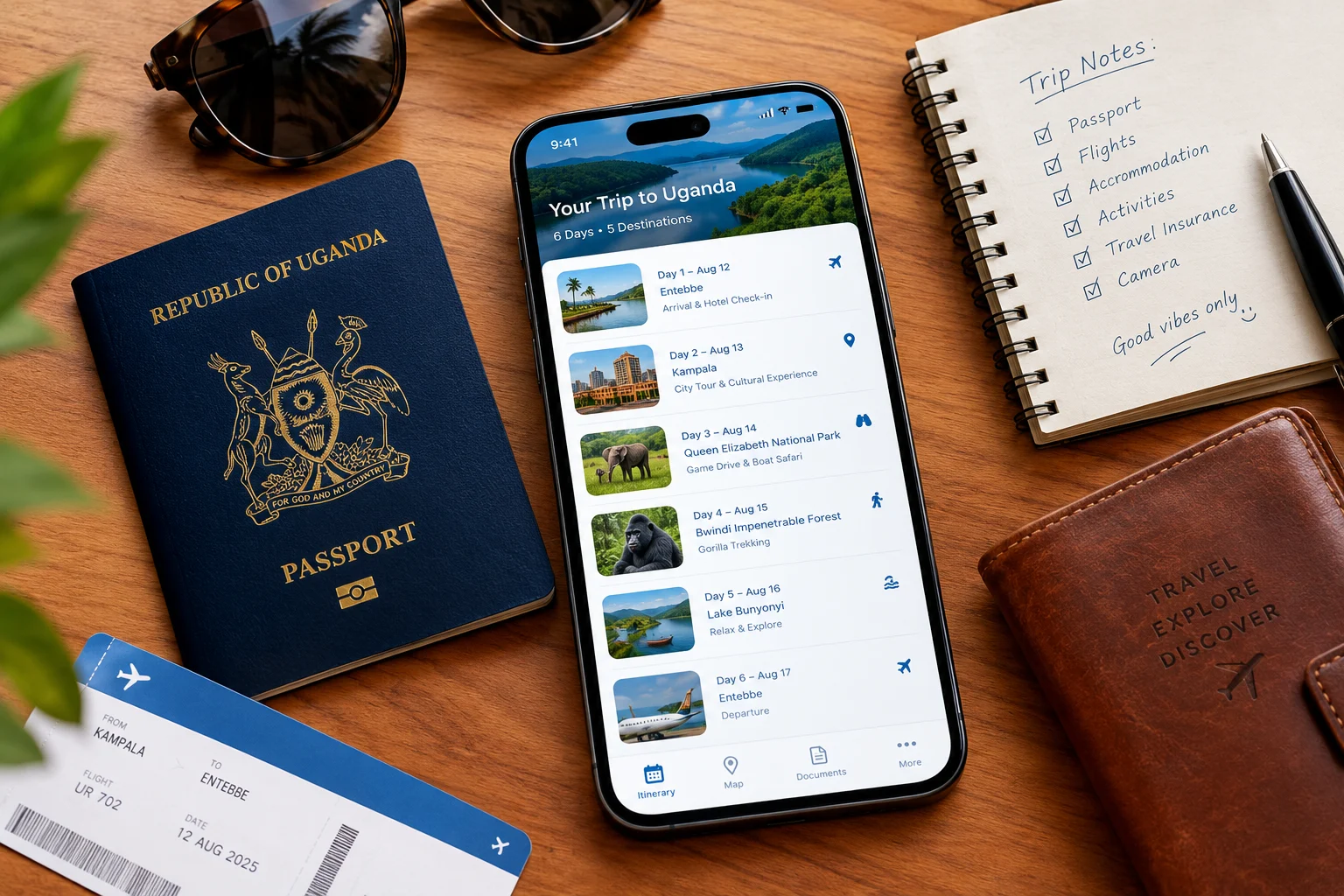
A Sample 5-Day AI Travel Itinerary in Uganda
Now let’s make the idea concrete.
Suppose you are visiting Uganda for five days. You want to experience some of the country without trying to squeeze ten destinations into a short holiday. You arrive through Entebbe, want time around Kampala and Jinja, and need to return to Entebbe for your departure.
A practical AI travel itinerary in Uganda might look something like this.
The important point is that this is an example of how to structure a trip, not a promise that every traveler should follow exactly the same schedule. Your flight arrival time, interests, budget, season, and travel companions should influence the final version.
Day 1: Arrive in Entebbe
Your first day should breathe.
After a long international flight, trying to visit several attractions immediately can turn your holiday into an endurance competition. A better approach is to arrive, collect your luggage, get settled, and give yourself time to adjust.
Entebbe can work well as a gentle starting point because it gives you access to the airport while still offering places to relax and explore. Depending on your arrival time, you could spend part of the day resting and then enjoy a quiet evening.
If you arrive early enough, you might visit a nearby attraction or simply take a walk and enjoy the slower pace. If you arrive late, there is no need to force sightseeing into the schedule. Rest is part of the itinerary too.
When building an AI travel itinerary in Uganda, arrival time should influence the first day. A flight that lands late should not be treated as though it lands at breakfast.
This is one reason flight search and itinerary planning belong together.
Zavi can help you compare the available flight times first. Once you know when you are arriving, you can make more sensible choices about what happens next.
The goal for Day 1 is simple: arrive safely, settle in, and start the trip without exhausting yourself before it really begins.
Day 2: Entebbe to Jinja
Day two can be your move toward Jinja.
Jinja is well known for its location along the Nile and its range of outdoor activities. It can give a short Uganda trip a very different feel from simply staying around the capital.
The journey itself should be part of your planning. Give yourself enough time rather than treating every minute as something that must be filled.
Once in Jinja, you could explore the town, enjoy the river environment, or choose an activity that matches your interests and budget. Travelers who want adventure have several options, while those who prefer a slower day can simply enjoy the surroundings.
A useful AI travel itinerary in Uganda does not need to schedule every fifteen minutes. That can make a holiday feel like a school timetable.
Instead, think in blocks. Morning, afternoon, evening. Give yourself a main activity, some flexibility, and enough time for meals and unexpected delays.
If you are travelling with children, that flexibility becomes even more valuable. Children do not always respect the itinerary you created at midnight while planning your holiday.
That is okay.
The itinerary is supposed to serve you, not the other way around.
Day 3: Jinja Experiences
Day three gives you a full day to experience Jinja without constantly packing and unpacking.
This is one of the advantages of a five-day trip with a limited number of destinations. You spend less time moving around and more time actually experiencing where you are.
Your activities could depend on the type of traveler you are. An adventurous traveler might choose a Nile-based activity. A couple might prefer a relaxed exploration of the town and surrounding areas. A family may want a mixture of sightseeing, food, and activities that do not require everyone to be exhausted by lunchtime.
This is where an AI travel itinerary in Uganda becomes personal rather than generic.
The destination does not change, but the itinerary can.
You can also use the planning stage to think about practical questions. What should you pack? How much time should you leave for road travel? What happens if weather changes your plans? Which activities need advance arrangements?
Zavi’s role is strongest around the travel and flight side of these decisions. For more detailed activity planning, you can also use trusted tourism resources and local advice.
For Uganda tourism information, Visit Uganda is a useful starting point.
The best itinerary is not the one containing the largest number of attractions. It is the one that gives you enough time to enjoy the attractions you actually care about.
Day 4: Return Toward Kampala
On Day 4, you can begin moving back toward Kampala and position yourself for the journey home.
This is another place where planning ahead helps. If your international departure is the following day, staying too far from Entebbe can create unnecessary pressure.
You do not want your final holiday memory to be sitting in traffic while repeatedly checking your watch.
Depending on your schedule, you could spend time in Kampala, visit a market, enjoy local food, explore cultural attractions, or simply use the day to relax before departure.
If you are travelling for business or visiting relatives, this day might look completely different. Perhaps you need time for meetings or family visits. That is perfectly fine.
An AI travel itinerary in Uganda is a framework, not a command.
This is also where the original flight information matters again. Your return flight time should influence where you spend your final night.
If your flight leaves early, staying closer to Entebbe may make more sense. If you have a later departure, you may have more flexibility.
The point is to connect each decision instead of planning each part in isolation.
Day 5: Departure From Uganda
The final day is about getting to the airport with enough time and without unnecessary stress.
Ideally, you have already confirmed your departure details and know how you are getting to Entebbe International Airport.
If your flight leaves later in the day, you may have time for breakfast and a final activity. If it leaves early, the itinerary should be much simpler.
This is a small example of why an AI travel itinerary in Uganda should be connected to actual travel times. A generic five-day itinerary might say, “Spend the morning exploring Kampala.” Your real flight might leave at noon.
That is not much of a morning.
A sensible itinerary works backward from fixed commitments. Your flight is fixed. Your airport transfer needs a buffer. Your departure preparation needs time. Everything else fits around those realities.
Before booking, make sure the final flight details, baggage rules, passport requirements, and other important travel information are confirmed.
For visa and entry information, use official government sources where possible. If you are unsure about a requirement, Zavi can help you look up entry information for planning purposes, but important requirements should be confirmed before you book.
The final day should feel like the end of a good trip, not the final boss battle.
AI Travel Itinerary in Uganda for Different Types of Travelers
There is no single perfect AI travel itinerary in Uganda because travelers do not travel in the same way.
A couple celebrating an anniversary might want fewer destinations and more time at each one. A family with children may prioritize convenient flight times and shorter travel days. A business traveler may care about arriving at a particular hour. A group may need different arrangements altogether.
That is why Zavi asks questions about the actual travelers rather than simply generating a generic plan.
Families, Couples, and Groups
Families are a good example.
If you are travelling with children, Zavi can take their ages into account during flight searching. That matters because children and infants can have different fare considerations from adults.
You may also have practical preferences that are not obvious from a basic flight search. Perhaps you want to avoid a long layover. Perhaps you prefer a departure time that does not require waking up the children at 3 a.m.
Couples can have different priorities. One couple may want the lowest fare possible. Another may value a better schedule because they have limited holiday time.
Groups introduce another layer. If you are travelling with a large group, a standard flight search may not be the best approach. Zavi can identify when a larger group needs a custom quote and connect you with a Travelcare advisor.
That human connection is important.
The purpose of an AI travel itinerary in Uganda is not to make every travel situation identical. It is to help you get the right information organized quickly and then bring in human expertise when the situation calls for it.
What Zavi Can Help You Check Before Booking
An itinerary can look great on paper and still fall apart when you start checking the details.
That is why the practical questions matter.
Zavi can help with flight searches, flight comparisons, and travel-related questions such as visa and entry requirements. If you are wondering whether a particular destination requires a visa for your passport, you can ask and use the information as part of your planning.
Entry requirements can change, though. For an AI travel itinerary in Uganda, visa information should be treated as planning information rather than a substitute for checking official requirements.
The same principle applies to baggage.
A flight might look cheaper until you discover that your luggage needs are different from what the fare includes. If you are travelling as a family, that can matter even more.
Here are some of the questions worth checking before you commit:
- What time does the flight depart and arrive?
- Is it nonstop or does it include a connection?
- What baggage allowance applies?
- Are children or infants travelling?
- Does the itinerary fit your planned activities?
- Do you need a visa or other entry permission?
- Is the trip one-way, round-trip, or multi-city?
- Would a different flight time make the trip easier?
For more complicated requests, such as First Class, Premium Economy, or multi-city travel, Zavi can move you toward a human Travelcare advisor rather than forcing you through a simple automated search.
AI Travel Itinerary in Uganda vs Traditional Trip Planning
Traditional travel planning is not bad. In fact, many travelers still prefer speaking with a person from the beginning.
The challenge is that traditional planning can sometimes involve a lot of waiting and repeated questions, especially when you are only at the research stage.
An AI travel itinerary in Uganda can speed up that early stage.
| Travel Planning Approach | AI-Assisted Planning With Zavi | Traditional Planning |
|---|---|---|
| Starting the search | Chat without an account | Usually contact an advisor or start a form |
| Trip details | Asked conversationally | Usually provided through a call, email, or form |
| Flight comparison | Real available options | Advisor searches options for you |
| Recommendations | Zavi explains a recommended option | Human advisor gives personalized advice |
| Complex trips | Can move directly to an advisor | Advisor handles the request |
| Booking | Connected to Travelcare advisor | Handled by Travelcare advisor |
| Human support | Available when needed | Central to the process |
The biggest advantage is not that AI is somehow “better than people.”
It is speed.
You can start exploring your trip without waiting for office hours or preparing a perfectly formatted request. Zavi can help turn a vague travel idea into a clearer request.
Then, when the trip becomes serious, you still have a real person involved.
That combination can be much more useful than either extreme: a slow manual process or a fully automated system that leaves you alone when something unusual happens.
When a Travelcare Advisor Takes Over
This is one of the most important things to understand about Zavi.
Zavi is not a self-service flight checkout system.
Its job is to help you search, compare, understand your options, and get ready to book. When you decide that you want to move ahead, Zavi collects the information needed to connect you with a real Travelcare advisor.
That advisor can then help finalize the booking.
Think of Zavi as the person who gets the conversation moving quickly, while the Travelcare advisor handles the part where human attention matters most.
This is particularly valuable when the trip is complicated.
Perhaps you have several destinations. Maybe you need a premium cabin. Perhaps your group is large. Maybe you have a special request that does not fit neatly into a standard flight search.
You do not need to force a complicated journey into a simple form.
The human handoff is part of the product, not a failure of it.
That distinction also makes Zavi a more realistic choice for travelers who like the speed of AI but still want reassurance from a real travel professional before committing money to a trip.
Your AI travel itinerary in Uganda can start with a conversation and end with a person helping you get the booking right.
Building a Better AI Travel Itinerary in Uganda With Zavi
The quality of your result depends partly on the quality of the information you provide.
You do not need to write a perfect travel brief. Just be clear about what you know.
Tell Zavi where you are leaving from, where you want to go, your dates, how many people are travelling, and whether there are children or infants. If your dates are flexible, say so. If you strongly prefer nonstop flights, mention that too.
It can also help to say what matters most.
Maybe your priority is price. Maybe it is convenience. Maybe you absolutely do not want a long layover. Maybe you are travelling for an important event and need to arrive by a particular day.
Those details give your AI travel itinerary in Uganda more useful context.
Then look at the recommendation rather than focusing only on the lowest number.
Ask yourself: Does this flight actually make my trip easier?
That question can save you from the classic travel mistake of choosing a cheap flight that creates expensive inconvenience later.
You should also keep some flexibility in the itinerary. Leave room for traffic, delays, meals, rest, and the unexpected moments that make travel feel like travel.
A five-day trip should not feel like you are racing a stopwatch.
Use the itinerary as your map. Do not treat it as handcuffs.
Why Zavi Works Well as the First Step
Planning a trip often begins before you are ready to book.
You might be checking prices at night. You might be comparing dates during lunch. You might suddenly remember that your passport needs checking while you are sitting on the sofa.
That is why having a conversational first step can be useful.
Zavi is available to help you start the process. You do not need an account before beginning the conversation. You can explain what you want and work through the details one question at a time.
That makes an AI travel itinerary in Uganda feel less like filling out paperwork and more like having a conversation.
But the important part is what happens after the search.
When you find a flight you like, you are not abandoned with a “good luck” button. You can move toward a Travelcare advisor who can help finalize the booking.
For travelers who want speed without giving up human support, that is the sweet spot.
Zavi gets you from “I need to plan a trip” to “I know which flight I want to discuss” much faster.
Conclusion: Build Your AI Travel Itinerary in Uganda With Zavi
A useful AI travel itinerary in Uganda is not about letting artificial intelligence make every decision for you. It is about removing some of the friction from travel planning so you can understand your options and move forward with confidence.
Travelcare’s Zavi helps you start with a simple conversation. It asks about your journey, checks the important travel details, searches real flight options, compares those options, and gives you a recommendation with a reason behind it.
You can use it when you are planning a family visit, a short Uganda holiday, a regional trip, or an international journey that begins or ends in Uganda.
And when you are ready to book, Zavi connects you with a real Travelcare advisor.
That human handoff is important. You get the speed and convenience of AI during the search stage without losing access to a person when it is time to finalize your travel plans.
If you are still exploring what AI can do for travel, start with the broader guide to an AI travel advisor in Uganda. If you already know where you want to go, chat with Zavi, compare real flight options, and take the next step with Travelcare.
FAQs About AI Travel Itinerary in Uganda
Q: What is an AI travel itinerary in Uganda?
A: An AI travel itinerary in Uganda is a trip plan developed with help from AI. Zavi can help organize your travel details, search real flight options, compare choices, and recommend an option. When you are ready to book, Zavi connects you with a real Travelcare advisor.
Q: Can Zavi create an AI travel itinerary in Uganda for my family?
A: Yes. Zavi can ask how many people are travelling and request children’s ages when needed. That helps make the flight search more relevant for families. For larger groups or more complicated arrangements, Zavi can connect you with a Travelcare advisor for additional help.
Q: Can an AI travel itinerary in Uganda include real flight prices?
A: Yes. Zavi searches and presents real available flight options with real prices and times. It does not need to use placeholder fares. Because flight availability and pricing can change, your selected option should be confirmed with the Travelcare advisor before booking.
Q: Can Zavi help with visa questions when planning an AI travel itinerary in Uganda?
A: Zavi can help you look up visa and entry requirement information for planning purposes. Travel requirements can change, so important information should always be confirmed with the relevant official authority or a Travelcare advisor before you book or travel.
Q: Does Zavi book my flight automatically?
A: No. Zavi is designed to help you search and compare flights, then connect you with a real Travelcare advisor when you are ready to book. The goal is to give you a faster start while keeping human support involved when it matters.
Planning a trip? Travelcare can help.
Flights, hotels, transfers, insurance & visas — one invoice, one advisor.