
KEY TAKEAWAYS
- AI flight booking in Uganda makes it possible to start a flight search conversationally instead of navigating multiple airline websites.
- Zavi, Simba Travelcare’s AI travel advisor, can search real fares in seconds and help travelers narrow down suitable flight options.
- Travelers can tell Zavi their route, dates, preferences, and other requirements in ordinary language.
- The process combines AI-powered searching with access to a real travel advisor when the traveler is ready to confirm or needs additional help.
- Compared with calling an agent or manually checking several airline websites, AI flight booking in Uganda can make the initial search faster and more convenient.
Table of Contents
If you are ready to book a flight, the first challenge is often not paying for the ticket. It is finding the right flight in the first place. You may have to check several airline websites, compare departure times, look at baggage rules, consider connections, and then wonder whether the fare you found is actually the best option for your trip. AI flight booking in Uganda offers a simpler starting point: tell an AI travel advisor what you need, let it search available options, and then move to a real advisor when you are ready to book.
That is where Zavi, Simba Travelcare’s AI travel advisor, comes in.
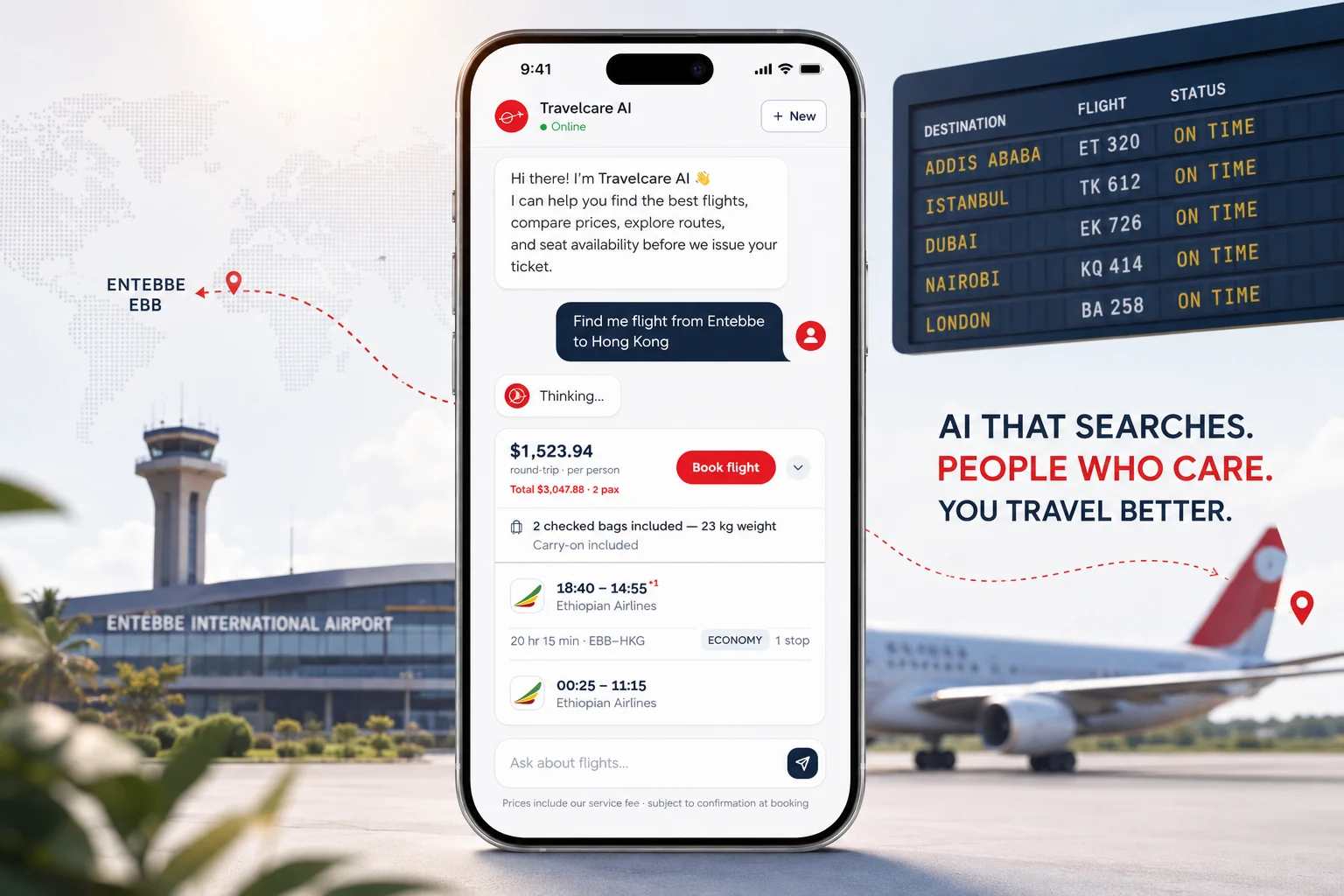
Instead of opening one airline website after another, you can begin with a conversation. Tell Zavi that you need a return flight from Entebbe to Dubai, for example, give your dates, mention your preferred departure time, and explain any important preferences. Zavi can search real fares in seconds and help you understand the options.
Ready to search for your next flight? Start chatting with Zavi for free.
The important part is what happens next. Zavi isn’t designed to leave you alone with an automated search result. The Travelcare model connects AI-powered flight searching with human travel expertise. In simple terms: AI searches, a real advisor takes it from there.
For travelers who are close to making a booking, that combination can remove much of the friction from the process.
What Is AI Flight Booking in Uganda?
AI flight booking in Uganda is the use of artificial intelligence to make the flight-search and booking journey more conversational and efficient. Rather than relying exclusively on traditional search boxes, a traveler can explain their requirements in natural language and receive assistance based on those requirements.
That distinction sounds small, but it changes the experience.
A conventional flight search might ask you to enter an origin, destination, departure date, return date, passenger count, and cabin class. That’s perfectly functional when you already know exactly what you want. But real travelers often begin with something less precise.
You might say, “I need to travel from Entebbe to Johannesburg sometime during the first week of November, preferably in the afternoon, and I don’t want a very long connection.”
That’s a human request, not a form.
An AI-powered travel system can interpret that kind of request and turn it into a structured search. If something important is missing, the conversation can clarify it. If you have flexibility, that can also be incorporated into the search.
This is the core attraction of AI flight booking in Uganda. The technology can help translate the way people naturally describe travel into a practical flight search.
There is another important distinction. AI flight booking should not be confused with an AI system simply generating flight suggestions from general information. For a traveler who is ready to purchase, current fare and availability information matters.
Zavi’s role is therefore focused on searching real fares and helping move the traveler toward a practical booking decision. When the traveler needs human assistance, Travelcare’s advisor can take over.
The result is a journey that combines speed, convenience, and human support.
Start With Zavi When You’re Ready to Book
Many travel tools are designed around inspiration. They help you dream about destinations, discover places, or read travel guides.
Zavi serves a different moment.
If you already know you need a flight and you’re ready to investigate your options, AI flight booking in Uganda can give you a faster way to begin.
Suppose you’re sitting at your desk in Kampala and you need to travel to Nairobi next Thursday. You don’t necessarily want to read ten articles about Nairobi. You don’t need a generic travel guide. You need to know which flights are available, what they cost, and which option makes sense for your schedule.
That’s a high-intent travel question.
Instead of opening multiple browser tabs, you can start by telling Zavi what you need.
For example:
“I need a return flight from Entebbe to Nairobi next Thursday, returning Saturday. I prefer an early morning departure and want to keep the total fare reasonable.”
That is enough to begin a conversation.
Zavi can then help search for relevant options and narrow the decision. If you have additional requirements, you can add them naturally.
Maybe you need checked baggage.
Maybe you have to arrive before a specific meeting.
Maybe you’re willing to pay more for a better departure time.
Maybe you don’t care which airline operates the flight as long as the itinerary is convenient.
These preferences can shape the conversation.
That is why AI flight booking in Uganda is particularly useful for travelers who are close to making a decision. The goal isn’t to make the traveler spend more time talking to AI. The goal is to reduce the time between “I need a flight” and “Here are the options that fit what I need.”
How AI Flight Booking in Uganda Works
The process is easier to understand when broken into a few practical stages.
First, you tell Zavi what you’re looking for. This could include your departure city, destination, dates, passenger information, and preferences.
Second, Zavi searches the relevant flight options and presents the available possibilities in a conversational format.
Third, you compare the options. You might ask which one leaves earliest, which one has fewer connections, or which option better fits your schedule.
Fourth, when you have identified the flight you want, you can move toward confirmation with a real Travelcare advisor.
That last stage is important.
AI flight booking in Uganda doesn’t have to mean that every part of the transaction is handled without human involvement. In fact, a hybrid approach can be more reassuring, particularly when the traveler has questions about fare conditions, changes, baggage, passenger details, or other booking considerations.
Think of Zavi as the fast lane into the travel conversation.
Instead of starting with a long phone call or manually searching through several airline sites, you start by explaining what you want. The AI handles the initial discovery. Human expertise remains available when the booking requires it.
The process can therefore be summarized as:
- Tell Zavi what you need.
- Search real fares.
- Compare suitable options.
- Choose the flight that fits your priorities.
- Confirm with a Travelcare advisor.
It’s straightforward by design.
Tell Zavi Your Route
The first thing most travelers want to communicate is their route.
For travelers in Uganda, that often means starting at Entebbe International Airport and traveling to another destination. Your route could be regional, such as Entebbe to Nairobi or Dar es Salaam. It could be continental, such as Entebbe to Johannesburg or Addis Ababa. Or it could be international, such as Entebbe to London, Dubai, Mumbai, or New York.
You don’t need to turn the request into technical aviation language.
Simply tell Zavi where you’re leaving from and where you’re going.
For example:
- “I need a flight from Entebbe to Dubai.”
- “Find me a return flight from Entebbe to London.”
- “I need to travel from Entebbe to Nairobi for two days.”
- “Can you find flights from Uganda to Johannesburg next month?”
The more information you provide, the more focused the search can become.
This conversational approach is one of the defining characteristics of AI flight booking in Uganda. You’re not trying to figure out how a booking engine wants you to phrase the request. You’re simply describing your journey.
And if your initial request is incomplete, that’s not a problem. Travel planning is naturally iterative.
You might begin with the route and dates, then remember that you need a checked bag. You might initially say that you’re flexible, then realize you need to arrive before noon.
The conversation can evolve as your requirements become clearer.
Get Real Fares in Seconds
When you’re ready to book, generic travel information isn’t enough. You need to know what flights and fares are actually available to consider.
That is why the concept of real fares in seconds is central to Zavi’s proposition.
Imagine the traditional process. You visit Airline A’s website and search your route. Then you open Airline B. Then perhaps Airline C. You write down the prices, check the times, compare baggage policies, and start again when you change your date.
It’s easy to lose track.
With AI flight booking in Uganda, the initial search can happen through a conversational interface. Zavi helps bring the relevant fare options into the conversation so you can focus on comparing them.
This doesn’t mean every fare remains fixed indefinitely. Airline inventory and pricing can change, and travelers should always confirm the final fare and conditions before purchase.
That is precisely why the human advisor stage remains useful.
The objective is to get you to the right decision faster, not to pretend that airfare is static.
For a traveler who has already decided, “I need to fly,” that can be a major improvement.
Instead of spending the first part of your journey hunting for information, you can spend it evaluating actual options.
Compare Flight Options Without Opening Endless Tabs
There’s a particular kind of frustration that comes with flight shopping: the browser-tab problem.
One airline website is open in one tab. A second airline is in another. A travel comparison website is somewhere else. You have your email open because you’re checking a meeting date. Your calculator is open because you’re trying to compare prices in different currencies.
Before long, finding a flight has become a mini research project.
An AI flight finder changes the interaction by putting the conversation at the center.
Rather than manually jumping between websites to answer every question, you can ask the assistant to help you explore the options.
“Which option arrives earliest?”
“Which flight has the shortest connection?”
“Are there options on this date?”
“What happens if I travel a day later?”
These are natural follow-up questions.
The value isn’t just that AI can search. It’s that you can continue the search without restarting the process every time your requirements change.
For busy professionals, that can be especially useful. Nobody wants to spend half an afternoon comparing flights when the actual purpose of the trip is a meeting, conference, site visit, or client engagement.
The better the search experience, the sooner you can get back to the reason you’re traveling in the first place.
AI Flight Finder vs Traditional Flight Search
An AI flight finder and a conventional flight-search website ultimately help travelers discover flights, but the interaction is different.
| Factor | Traditional Flight Search | AI Flight Finder |
|---|---|---|
| Starting point | Structured form | Natural-language conversation |
| User input | Specific fields | Flexible travel request |
| Follow-up questions | Usually requires a new search | Can continue conversationally |
| Comparing preferences | Often manual | Can be discussed conversationally |
| Exploring alternatives | Requires repeated searches | Can refine the same conversation |
| Human support | Depends on provider | Zavi connects to Travelcare advisors |
Neither approach eliminates the need for careful booking. Travelers still need to check passenger details, dates, baggage, fare conditions, and other relevant information before confirmation.
The difference is the front end of the decision-making process.
Traditional systems expect the traveler to operate the system.
AI systems attempt to understand the traveler.
That is an important shift.
For someone who knows exactly what they want, a standard search form may be perfectly adequate. But for someone who wants to ask questions while searching, an AI flight finder can feel considerably more natural.
This is especially relevant when several variables matter at once. You might care about price, departure time, arrival time, baggage, connections, and flexibility. Rather than treating each variable as an isolated field, conversational AI can help you think through them together.
That’s where AI flight booking in Uganda becomes more than a different interface. It becomes a different way of approaching the booking decision.
AI Flight Booking in Uganda vs Calling a Travel Agent
Calling a travel agent has a major advantage: you are speaking to a person.
If your trip is complicated, that can be extremely valuable. A good advisor can ask questions, understand context, and help you work through alternatives.
But calling an agent can also involve waiting. You may need to explain your requirements, wait for the search, receive options, ask another question, and then wait again.
For travelers who are simply trying to discover what is available, AI can accelerate the first part of that process.
That’s one of the strongest use cases for AI flight booking in Uganda.
You can start searching immediately. You don’t have to wait for someone to answer a phone call just to ask, “What flights are available from Entebbe to Nairobi next Tuesday?”
At the same time, Zavi doesn’t require travelers to abandon human assistance.
This is where the hybrid model becomes powerful.
AI searches first. A real advisor can take it from there.
So the choice isn’t necessarily:
AI vs human.
It can be:
AI for speed + human expertise for confidence.
That is particularly useful for travelers who want to move quickly but still appreciate knowing that a professional advisor is available when they reach the booking stage.
Why Entebbe Is the Natural Starting Point
For many travelers using AI flight booking in Uganda, the journey begins at Entebbe International Airport. As Uganda’s primary international gateway, Entebbe connects travelers to regional and long-haul destinations through a network of airlines and connecting hubs.
That makes the quality of the initial search particularly important. A traveler isn’t simply asking, “What flights exist?” They are usually asking a more practical question: “Which available flight makes sense for my trip?”
Consider someone traveling from Kampala to Dubai for a three-day business meeting. They may care about arriving at a particular time, minimizing connection time, carrying checked luggage, and returning on a specific day. A flight that looks inexpensive at first glance may not be the most useful once those factors are considered.
This is where an AI flight finder can make the conversation easier. Rather than treating the trip as a single price comparison, the traveler can explain the circumstances around the journey.
Entebbe is also an important starting point for regional travel. Business travelers regularly need to move between Uganda and destinations such as Nairobi, Kigali, Dar es Salaam, Addis Ababa, Johannesburg, and other commercial centers. Leisure travelers may be looking toward destinations in Africa, the Middle East, Europe, and beyond.
For each route, the priorities can be different.
That’s why conversational searching has an advantage. You can tell Zavi what matters for this particular trip, rather than relying on a one-size-fits-all search.
For someone booking a flight from Uganda, the goal isn’t merely to locate an itinerary. It is to find one that fits the reason, timing, and circumstances of the journey.
What Information Should You Give Zavi?
You don’t need to write a perfect travel brief before starting a search. However, the more useful information you provide, the easier it becomes for Zavi to understand what you’re trying to accomplish.
At the basic level, consider providing:
- Departure point: Usually Entebbe for international journeys from Uganda.
- Destination: The city or airport you need to reach.
- Travel dates: Include return dates if you’re booking a round trip.
- Number of travelers: Adults, children, or other passenger categories where relevant.
- Cabin preference: Economy, premium economy, business, or first class.
- Timing preferences: For example, morning departures or evening arrivals.
- Baggage needs: Particularly if checked luggage is important.
- Flexibility: Mention whether you can travel a day earlier or later.
- Budget: If you have a particular spending limit or target range.
You can provide these details all at once, or you can start with the basics and add information as you go.
For example:
“I need a return flight from Entebbe to London for one adult, leaving 10 October and returning 17 October. Economy is fine, but I’d prefer a reasonable connection and checked baggage.”
That’s much closer to the way people actually talk about travel than a collection of booking fields.
The benefit of AI flight booking in Uganda is that you can begin with your intention and refine the details as the search develops.
If you aren’t sure which dates are best, say so. If you’re price-sensitive, mention it. If getting to a meeting on time matters more than saving a little money, make that clear.
Travel decisions are rarely just about price. Giving Zavi the context behind the trip can make the search more useful.
Flexible Dates, Preferences, and Travel Priorities
Airfare decisions often involve trade-offs.
You might save money by traveling on Wednesday rather than Tuesday. A particular flight might cost slightly more but save several hours. Another option could have a longer connection but a departure time that works better for your schedule.
This is where AI flight booking in Uganda can become particularly useful because travelers can discuss those trade-offs rather than simply staring at a list of prices.
Imagine that your first search produces an option that costs more than expected. Instead of immediately abandoning the search, you can say, “I’m flexible by one day. Can you check whether another date is cheaper?”
Or perhaps price isn’t your biggest concern. You might say, “I have an important meeting the morning after I arrive, so prioritize an itinerary with a convenient arrival time.”
That changes the objective.
A useful AI travel assistant shouldn’t assume that the cheapest ticket is automatically the best ticket. The cheapest fare can become expensive in practical terms if it involves inconvenient timing, lengthy connections, restrictive conditions, or other compromises that don’t fit your journey.
The smarter question is:
What combination of price, time, convenience, and flexibility works for me?
Zavi can help travelers explore that question conversationally.
This is also where human advisors remain valuable. If the options involve complicated fare conditions or an unusual itinerary, a professional can help explain the practical implications before the traveler commits.
From AI Search to Human Advisor
The most important part of Travelcare’s Zavi experience is what happens after the AI search.
You have explained your trip. The relevant fare options have been found. You’ve narrowed them down.
Now what?
This is where the model becomes deliberately human.
AI searches, a real advisor takes it from there.
Instead of forcing you to complete every stage through automation, Zavi can connect the search experience with Travelcare’s travel professionals. That means you can get the speed of AI without losing access to someone who understands the realities of travel booking.
This matters because the final booking is a precision exercise.
Names must be correct. Dates must be correct. Passenger details need attention. Fare rules matter. Baggage conditions can affect the total value of a ticket. If something changes later, knowing who to contact can make a significant difference.
A human advisor can also help when the itinerary doesn’t fit neatly into a standard search.
Perhaps you’re booking travel for several employees. Maybe you need a multi-city itinerary. Perhaps a traveler has a particular requirement. Or maybe you’re simply unsure which of two options makes more sense.
AI can get you to the conversation faster.
The advisor can help you finish it with confidence.
That is the distinction between using AI as a novelty and building AI into an actual travel service.
Why Human Support Still Matters
Travel looks simple when everything goes according to plan.
You arrive at the airport, check in, board the aircraft, land at your destination, and continue with your trip.
But what happens when something changes?
A flight is delayed. A connection becomes difficult. A schedule changes. A passenger needs to modify a ticket. A business meeting moves to another day.
Suddenly, the value of having a real travel professional becomes obvious.
Human advisors can interpret circumstances that may not fit neatly into an automated workflow. They can communicate with travelers, help identify practical alternatives, and provide reassurance during stressful situations.
This is especially relevant to corporate travelers. A delayed executive isn’t merely experiencing an inconvenience. They may be missing a client meeting or important presentation. A disrupted project team’s travel could affect an entire schedule.
That’s why the promise of AI flight booking in Uganda shouldn’t be interpreted as “no humans required.”
A better description is technology where technology works best, people where people work best.
Zavi handles the speed of discovery. Travelcare’s advisors remain available for the expertise and personal support that complex travel can require.
For customers, that can be the best of both worlds.
AI Flight Booking for Business Travelers
Business travel has a different definition of convenience.
A leisure traveler may be willing to accept a long connection to save money. A business traveler traveling to a meeting may not.
Imagine a Kampala-based sales director traveling to Nairobi for a morning presentation. The most important consideration may be arriving early enough to handle an unexpected delay, rather than finding the absolute cheapest ticket.
Or consider an executive traveling to London for a two-day meeting. A slightly more expensive itinerary may be worthwhile if it avoids an unnecessarily long connection and protects valuable working time.
This is where an AI flight finder can help structure the initial search around the actual purpose of the trip.
Instead of simply saying, “Find the cheapest flight,” the traveler can communicate the real priority:
“I need to arrive in London in time for a 9 a.m. meeting the next day. Prioritize a practical itinerary over the absolute lowest fare.”
That distinction can produce a much more useful conversation.
For companies, the value extends beyond individual bookings. Employees can start their searches quickly while the organization retains access to professional travel management support.
For frequent travelers, saving time on each search can also add up. Five minutes saved on one booking may not sound important. Multiply that across dozens or hundreds of trips, and the operational benefit becomes much more noticeable.
AI Flight Booking for Leisure Travelers
Leisure travelers can benefit from the same speed, but their priorities may be different.
A family planning a holiday might care about baggage, convenient departure times, child-friendly schedules, and avoiding exhausting connections. A solo traveler might prioritize the lowest reasonable fare. A couple might prefer a flight schedule that maximizes time at the destination.
There is no single definition of a “good” flight.
That’s why an AI travel assistant can be useful as a conversational planning partner. Instead of simply displaying options, it gives travelers a place to explain what matters.
A traveler can start broadly:
“I’m planning a holiday from Uganda and I’m flexible about the destination. I’d like somewhere warm and would prefer to keep the airfare reasonable.”
The conversation can then become more specific.
What month?
How many days?
How many travelers?
Direct flight or connection?
What budget?
How important is baggage?
The result is a planning experience that begins with a person’s preferences rather than a rigid form.
And when the traveler reaches the point where they’re ready to confirm an itinerary, the human advisor remains part of the process.
Common Mistakes to Avoid When Booking Flights
Even with better technology, travelers should avoid treating a flight search as nothing more than a race to find the lowest number.
A cheap fare isn’t necessarily the best value.
Before confirming a ticket, consider these common mistakes.
Choosing Price Without Considering the Schedule
A fare may be cheaper but involve an inconvenient departure or arrival time. If that creates additional accommodation, transportation, or productivity costs, the initial saving may not be meaningful.
Ignoring Baggage Conditions
Two apparently similar fares can have different baggage allowances. If you need checked luggage, make sure the fare you choose actually accommodates your needs.
Entering Passenger Details Incorrectly
Names and travel-document information deserve careful attention. Errors can cause problems later and may be difficult or costly to correct.
Assuming Every Fare Is Fully Flexible
Some tickets have strict change or cancellation conditions. Always understand the relevant fare rules before confirming.
Waiting Too Long After Finding a Suitable Fare
Airline inventory and pricing can change. If you’ve found an option that fits your needs, don’t assume the same fare will necessarily remain available indefinitely.
This is another reason to have a human advisor available. When you’re uncertain, asking someone with travel expertise can be more valuable than guessing.
What to Check Before Confirming Your Ticket
Finding a flight is one step. Confirming the right flight is another.
Before you finalize your booking, take a moment to verify the details.
Check your itinerary carefully:
- Passenger names — Make sure names match the relevant travel documents.
- Dates — Confirm both departure and return dates.
- Departure and arrival airports — Check the actual airports, especially when a destination has multiple airports.
- Departure times — Make sure the schedule works with your plans.
- Connections — Review the number and duration of connections.
- Baggage allowance — Confirm what is included with your fare.
- Fare conditions — Understand applicable change, cancellation, or refund rules.
- Passport and entry requirements — Verify requirements applicable to your nationality and destination through authoritative sources.
- Final price — Confirm the amount payable before completing the transaction.
The advantage of using AI flight booking in Uganda is that the initial discovery can be faster. But speed should not encourage careless confirmation.
A good booking process combines convenience with attention to detail.
When you’re uncertain about any part of the itinerary, that’s precisely the point at which a Travelcare advisor can add value.
The Future of AI Flight Booking in Uganda
The way people book flights is changing.
For years, the dominant digital model was simple: open a website, enter search fields, compare results, and book. That’s still useful, but conversational AI introduces another possibility.
Instead of asking travelers to operate the booking system, the system can begin to understand the traveler.
That could make AI flight booking in Uganda increasingly relevant as more people become comfortable using AI for everyday tasks.
The opportunity isn’t limited to cheaper or faster searches. AI can potentially make travel discovery more personalized by considering the context behind a trip.
A business traveler may prioritize arrival time.
A family may prioritize convenience.
A student may prioritize affordability and baggage.
An executive may prioritize flexibility.
Different travelers can ask the same basic question—”Find me a flight”—and mean completely different things.
The technology becomes valuable when it can understand that difference.
But the strongest future model is unlikely to be purely automated. Travel is too dynamic, and travelers still value human reassurance. The more complex the journey becomes, the more useful professional expertise can be.
That is why Zavi’s approach is significant.
It isn’t simply about adding AI to flight searches. It’s about creating a bridge between instant digital discovery and real human travel support.
Why Zavi Changes the Starting Point
The biggest change Zavi introduces may be surprisingly simple: you can start with a conversation.
You don’t have to know which airline you want.
You don’t have to understand every booking term.
You don’t have to open six airline websites before you know what’s available.
You can simply explain the trip.
That makes Zavi particularly relevant for travelers who are ready to search but don’t want the traditional hassle of flight shopping.
And because the experience is connected to Travelcare’s human advisors, the traveler isn’t left alone once the search is complete.
That’s the real proposition behind AI flight booking in Uganda.
Not technology for technology’s sake.
Not an attempt to eliminate human travel professionals.
A faster way to find realistic flight options, followed by human assistance when you want or need it.
For someone standing at the beginning of a trip, that can be a meaningful difference.
Conclusion
AI flight booking in Uganda is changing the starting point for travelers who want to find flights quickly without sacrificing access to human expertise. Instead of jumping between airline websites or waiting for an agent to search manually, you can begin by telling Zavi what you need.
Zavi, Simba Travelcare’s AI travel advisor, is designed to search real fares in seconds and help travelers explore suitable options. You can provide your route, dates, preferences, budget, baggage needs, and other requirements in ordinary language.
Then comes the part that makes the experience different: AI searches, a real advisor takes it from there.
That hybrid approach brings together the convenience of technology and the judgment of professional travel advisors. You get a faster way to discover your options while retaining human support when you’re ready to confirm your booking or when your journey becomes more complicated.
If you already know you need to travel from Uganda, there’s no reason to make the first step harder than it needs to be.
Start chatting with Zavi for free, search your next flight, and let Travelcare help you take it from search to booking.
Frequently Asked Questions
Q: What is AI flight booking in Uganda?
A: AI flight booking in Uganda uses artificial intelligence to help travelers search and compare flight options through a conversational experience. With Zavi, travelers can explain their route, dates, preferences, and requirements, search real fares, and then connect with a Travelcare advisor for booking assistance.
Q: How does Zavi work as an AI flight finder?
A: Zavi works as an AI flight finder by allowing travelers to describe the trip they need in natural language. It can help search relevant flight options and fares, after which travelers can refine their requirements and proceed with a real Travelcare advisor when they are ready to confirm.
Q: Can I search flights from Entebbe using Zavi?
A: Yes. Travelers can use Zavi to begin searches for journeys departing from Entebbe International Airport. Provide your destination, travel dates, passenger details, and preferences, then refine the search as needed before moving toward confirmation with a Travelcare travel advisor.
Q: Is AI flight booking better than calling a travel agent?
A: AI and human travel assistance serve different purposes. AI can make initial flight discovery faster, while a human advisor can provide judgment and support for complicated itineraries, changes, special requirements, and booking questions. Zavi combines both through its AI-plus-advisor approach.
Q: Can a real advisor help after using Zavi?
A: Yes. The Zavi experience is designed around the principle that AI searches, a real advisor takes it from there. Once you’ve found a suitable flight, Travelcare’s human advisors can assist with confirmation and other travel requirements where professional support is useful.
Planning a trip? Travelcare can help.
Flights, hotels, transfers, insurance & visas, one invoice, one advisor.